The 'unmusical' label: A verdict of self judgement
Eve Ruddock and Sam LeongThe University of Western Australia

[ Abstract for this presentation ] [ Proceedings Contents ] [ Schedule ] [ Abstracts ]
The 'unmusical' label: A verdict of self judgementEve Ruddock and Sam LeongThe University of Western Australia |
|
The phenomenon of people labelling themselves as unmusical is widespread and terms such as talent, giftedness and musicality characterise the research field. This paper presents four case studies of adult non-musicians (a lawyer, a teacher educator, a teacher, and a public servant), providing perspectives of the impact of self-view on their self-judgement of musicality. A major negative consequence is the deprivation of self from future active participation in and enjoyment of music making.
Must the majority be made unmusical so that a chosen few may become more musical? Blacking, 1976
In 1938, with the publication of Seashore's seminal Psychology of Music, it was articulated clearly that only a select minority of people are deemed to be musical in our society (see also Shuter-Dyson, 1999). Seashore's understandings and subsequent judgements have echoed powerfully down the years. Yet John Booth Davies (1978) holds that music making and music appreciation are accessible to everyone in different ways, despite the fact that there is no appropriate means of either precisely defining or of quantifying (Serafine, 1988) this elusive phenomenon. Serafine (1988) highlights the problem that is widespread in discussions on musicality when she questions the assumption that only some people are born musical and that they are the ones who can become musicians. Focusing on music as cognition, her research convinces Serafine that music is not an innate talent, rather, it is something that results from normal cognitive development in a musical environment.
While acknowledging the importance of the individual's latent ability Shuter-Dyson (1999) also recognises the interdependence of aptitude, teaching and interest. She also notes that the development of musical abilities depends upon being in an environment that values music (Shuter-Dyson, 1999). In line with Anglo-American research into music ability, where the emphasis is on the comparative acuity of individuals' aural skills, Shuter-Dyson's work targets those people who are capable of attaining high levels of musical excellence in a world where, to be considered musical, an individual must exhibit a high degree of ability along with commitment. She notes that the majority of people, who are judged to have inferior aural skills, do not find it easy to access active music and so must remain witnesses to the music act. When Shuter-Dyson suggests that adults might be encouraged to seek active participation in music if they could achieve good results on a music ability test, she acknowledges the prominence of two elements firmly embedded in our musical culture; ie. performance and competition.
O'Neill (1997) reports that children in school are often subjected to tests which claim to discern musical ability. Results determine who will receive an offer to learn a musical instrument, or be included in the school choir and this selection process leads to a situation where only a minority of children gain access to formal music learning opportunities. In their study of successful musicians, however, Sloboda and Howe (1991) found that extraordinary early music development was not obvious with most of the participants. While Sloboda et al. (1994) accept that biological differences do play a significant role when it comes to some individual's potential abilities, they stress that we still have a long way to go towards understanding how these skills develop. They recognise that the situation is far more complex than that suggested by "the notion of innate talents or gifts" (Sloboda et al., 1994, p. 351) and note that assumptions about being musical or unmusical account for some individual's responses to musical engagement and whether or not they seek access to music learning.
It is seen then, that the current situation in our highly industrialised society means that performance of music is carried out only by individuals who have been judged to possess innate potential and who then worked hard to develop high levels of competence (Shuter-Dyson, 1999). Since the publication of Blacking's perceptive How Musical is Man? (1976), the notion that only the chosen few are musical is increasingly being questioned and researchers are starting to ask questions about musicality that address everyone, not just the apparently talented (Austin & Vispoel, 1992; Hallam & Prince, 2003; Sloboda et al., 1994). In this paper, it is our intention to step back from the case of the musician with all the associated concepts of training and talent (Merriam's italics) (Merriam, 1964, p. 131) and from musical ability with its focus on acquired attributes (Hallam & Prince, 2003; Shuter-Dyson, 1999; Sloboda et al., 1994) in order to explore the relationship between the non-musician's concept of musical and her consequent self-judgement as she lives within our Western culture. Findings from the four cases will be reported with the following three questions in mind: (a) What do the participants understand by the term musical? (b) what factors may have contributed to their conception? And (c) how does their understanding impact on their involvement with music?
The researcher's role have been to facilitate an understanding of the conversational partners' perceptions of musical (Minichiello, et al., 1995; Patton, 1990; Rubin & Rubin, 1995) so that some insight is gained about how these perceptions affect everyday participation in music. In-depth recorded interviews reveal how these non-musician participants view musical and how this understanding affects their lives.
At a venue of the interviewee's choice, recorded conversations explored the experiences and understandings regarding perceptions of musical. All four participants chose to provide details of age, gender and music learning background. They shared thoughts about their families regarding the musical aspects of their lives and to what extent they might consider themselves as musical beings. Entering into the spirit of the research, they endeavoured to uncover how they, as non-musicians understood music and included it in their lives. Transcriptions of interviews, together with specific questions where pertinent, were later forwarded to each informant as part of the member checking process (Punch, 1998). Two transcripts were returned to the researchers with extensive annotations and these added another layer of information for the analysis thus contributing further to the emerging understanding.
Analysis proceeded with categorisation (Patton, 1990; Rubin & Rubin, 1995) involving an iterative process identifying similar and contrasting perceptions. The focus of analysis centred on the participants' perception of musical and the consequent impact this has on their participation and enjoyment of music making. The cases represent disparate backgrounds, age groups, attitudes and levels of involvement in music. They are reported in order from the least to the most musical person in accordance with their self-judgement criteria.
Michael is like me, and he can't really hear it. But...I hope, that by doing music for four years...that he is able to hear it and analyse it...far better than I ever will...and, perhaps, at some stage, if he begins to realise that...there is a whole musical world, he will be able to enter it because he has some basic knowledge...if he wants to.Although Nell claimed towards the end of the interview that she "never felt [she] wanted to make music", she did remember that she "really did want" to learn the guitar when she was in her mid teens. However:
I couldn't do it. I didn't like it...I just couldn't hear it...hated it...I...couldn't hear the difference between one chord to another...and...I think I didn't do enough practice...I didn't understand what a note was...I just felt it was a foreign language and I just couldn't grasp it.Nell's memories of her attempts to learn guitar reveal that she had no conception of "effective learning strategies" (Austin & Vispoel, 1992, p. 4) at the time, so that her efforts proceeded with a sense of confusion. Her self-judgement about her lack of musical ability was total. In her demographic information, she indicated that she had learned singing for two years, yet no mention was made of this in her interview. Her handwritten reason for this is revealing:
I think because it was a negative experience and I don't tend to remember it. I also don't tend to mention (admit to it!) usually because people would then expect me to know something musically.Table 1 below presents a brief example of Nell's view of musical and the consequent impact on her lack of musical involvement.
| Concepts | Interview excerpts | Interpretation |
| Music | Just...just notes, notes in succession that you find pleasant for some reason...usually with a voice...for me, voice. | Impersonal, perhaps indicating a lack of emotional connection. |
| Musical | I wouldn't say any one of my family is musical in that respect. I don't think...anyone of them has got the tools to analyse music... | Importance lies in understanding, ie. in being able to analyse music, to know about structure and content. |
| Formal music lessons | ...we had a theory lesson and it seemed to me there was no connection between the guitar lesson and theory lesson and I can remember at the time saying it's as if someone hasn't given me the key as in um...a key on a map. | Formal lessons were not helpful for Nell to get to know and 'do' music. |
| Understanding | I like to think it was bad teaching...a lack of coordination between the theory and the practice. I think there was a little bit of that, but let's face it...a lot of other people did manage to learn...through that system. I think also I just had no...innate ability...to understand it. | Self-judgement of not being musical because she could not understand whereas others could. |
| Music making | ...was regarded as magic, I think. Just about. Still regard it as magic really...it's a very difficult thing to do I should think. | Despite her awareness of her children's potential to learn, she remains alienated from the music world herself. |
On three occasions in his first interview, Harry referred himself as to being musical in the context of being a "receiver of music" and a jazz fan, however, he made no comments about being unmusical. Responding to a question six months after that interview, he answered: "I can't hold a tune. I can't even sing in the shower." One week following this comment, in his second interview, he made seven references to being musical as in appreciation of music and ten references to being not musical when referring to playing or to having musical talent. This self-view was formed in his mid teens when, after discovering his passion for jazz, he determined to go "a stage beyond that...to see whether I could actually produce...it myself...[as] an extension of just listening to it". While he considered that his jazz music was influential in his social and emotional life and that it contributed to his "defining myself as me", his verdict regarding his ability to make his own music was negative: "well, at that point, I couldn't. The...possibility [was] there but it was not something which came easily". As an educator, he recognised that: "to get to be a talented performer, everybody has to put the hard yards in." Yet his initial efforts at making his own music led quickly to his labelling himself as unmusical "partly due to...the feedback of [lack of] instantaneous success or the disappointment...the results were not as...attractive as one might've wished". He did acknowledge later in the interview that a person could, "with a lot of effort become a genuine performer".
When discussing the notion of being "talented" or "appreciative" with reference to his young grandchildren, he has not found any indication that they were musical or mathematical. He agreed that young children whose "[mathematical] capacities haven't been excited or operated on because they haven't learned any of this sort of stuff yet, and...others for whom this is just not part of their life" should be given the chance to develop mathematical understanding through effective teaching. This position of supporting learning in mathematics for novices was not evident in his view of music learning. Yet recent research indicates that musical "skills [like mathematical skills] are perceived as being developed through opportunity and effort" (Hallam & Prince, 2003, p. 19).
Table 2 below presents a brief example of Harry's view of musical and its consequent impact on his musical involvement.
| Concepts | Excerpts from raw data | Interpretation |
| Musical | ...is a thing one is or one isn't | Innate ability - the 'talent' notion |
| Musical | to be musical could be 'appreciative' or 'talented' | Two distinct aspects comprise musical |
| Musical - in appreciative sense | So someone who can't appreciate music would not be musical...and, the apologic sense of it usually is that you can't play an instrument or make music and therefore not musical. I enjoy it and it is a...for me a significant and enriching part of my life | Self-judgement as musical in appreciative sense |
| Emotional aspect (appreciative) | [I have been] very uplifted by and helped...[by some music which can] excite and please...there have been some pretty heavy times when...[music can help] and in that sense music is significant. But I'm not musical. | In acknowledging the powerful affects of music, his comment "but I'm not musical" is significant. |
Rhonda's negative judgement of her ability levels is not reflected in reduced levels of enjoyment, however, since she still loves singing and listening to music in the car or when with others in a social situation. Her perception of musical was divided distinctly into two, the active making of music and the enjoyment of listening to others. Like Harry and Ada, the fourth participant, she considered herself musical when referring to her enjoying music; but this notion of being musical did not extend to her playing an instrument or singing. Revealing feelings of reticence about playing or singing in public, she emphasised the importance of acting in socially acceptable ways. Her experience convinced her that for a non-musician to sing or play in public was to risk being embarrassed and to be judged unmusical.
While she recognised her students demonstrated that doing musical things was normal, she considered that to play an instrument was to appear to be different and that, for a non-musician to play or sing was to draw attention to yourself and to be judged. Acutely aware that it is the "judgemental...and...critical nature of people" in our particular society causing such reticence, she commented that, for a person to:
Start singing, people would look at you like...which mental institution has she just gotten out of...[they might think] it's the worst thing I've ever heard! Everyone walks along, but not everyone plays musical instruments. Everyone walks. But not everyone plays instruments! [Making music like that is] drawing attention to yourself.Rhonda was aware that the fear of judgement by others dominated her actions in public and stressed the importance of group acceptance. She did not want to risk being different. In her view, for a non-musician to do something musical could threaten her approval status since musical acts rightly belonged to those who are trained as professional musicians and who possess the necessary abilities and experience.
Table 3 below presents an example of Rhonda's view of musical and its consequent impact on her musical involvement.
| Concept | Excerpt from raw data | Interpretation |
| Musical | Musical in playing instruments - no; musical in enjoying music - yes." | Music viewed as two distinct aspects for human action. |
| Music and emotions | "some music...emotionally stirring like it actually brings emotion into you." | Appreciates music as something that can evoke emotions. |
| Performance judgement | I for example didn't play a musical instrument because I felt that I just was shocking when I did try - and that everyone else would...would think that I didn't know how to do it right." | Refraining from active involvement in music making because of the fear of being judged. |
| Development of musical performance skills | So the fear that people might be maybe judging you...finding you wanting in that area...would then stop you having a go, even though, if you haven't had a go, how can you perform with any competence? | Reveals awareness of need for opportunities to develop musical performance skill s. |
After arriving in Australia and finally getting the opportunity to go to singing lessons, her conception of her own musicality changed. It came as a shock when, as a widow and finding the chance to learn singing formally, she gradually came to see herself as having inferior aural skills. This self-judgement may be seen as a result of her increased awareness of singing technique and aural skills acquired because of formal lessons together with the effect of living with a son who had high aural discrimination ability and who possessed a musical memory such that he could pick out tunes on an instrument and remember music themes with little effort. In her hour-long interview, Ada made three references to being not musical. However, she never suggested that she was unmusical in any way, because, despite her recent reservations about her musical ability, she still considers herself to be a musical person. For her, music making and music appreciation are necessary aspects of her life because she sees life and music as an integral process.
Table 4 below presents an example of Ada's view of musical and its impact on her musical involvement.
| Concept | Excerpts from raw data | Interpretation |
| The meaning of musical |
|
Ada refers to aural skills as an important component of musical ability. She also recognises that musical refers to a theatrical production. |
| Self-judgement regarding aural skills | A musical ear is someone, not like me, unfortunately, but someone who can pick up the notes, the sound, like my son. He listens to something and then plays it...never having been taught. Plays on a keyboard because he knows the sound. | Ada recognises a musical person is one who can hear, remember and then reproduce musical patterns. Because she cannot do this immediately, her self-verdict is that she is not musical. |
| Musical ability | You see, this is what I call musical ability: to be able to listen to something, some music, to appreciate, to know...to be able to appreciate the finer things of music...that's musical! | To listen, to appreciate, and to understand is to be musical. |
| Unmusical | Unmusical...is someone who has no interest in music ok. They don't have time to listen...they just can't make two notes together...that's, to me, unmusical. | A person is unmusical if they do not make music or avoid listening to music. |
| Music making at home | [My sister] bought a piano and her children are playing...she can't play [although] she'd love to play. I'd love to play...It was always...more important to my father [for us] to learn the language and go out and get a job. | Music learning was seen to be an 'extra' by her father who saw music as an option, not a necessity (yet he often had a piano in the house for other people to play). |
Figure 1 below represents the four non-musician participants on a continuum from the least to the most musically involved (their self-verdict). Their self-judged placement is consistent with their early musical experiences at home.
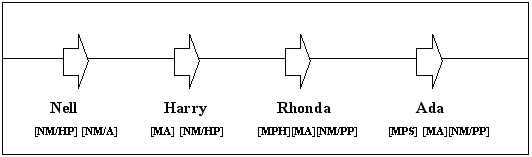
Figure 1: The musical continuum: Four non-musician participants
| Notes | MP | Musical as competent performer (sing or play privately and in public) |
| MPH | Musical as performer at home or non-public place (sing or play privately) | |
| MPS | Musical as social performer with others at home or non-public place (sing or play privately with others) | |
| MA | Musical as appreciator (listen or appreciate) | |
| NMPP | Not musical as solo performer in public (do not sing or play by self in public) | |
| NM/HP | Not musical as non-public performer (do not sing or play privately at home or other non-public venue) | |
| NM/A | Not musical as appreciator (do not listen or appreciate) |
Findings from current research acknowledge the important role played by "opportunity and effort" as a basis for the attainment of effective musicianship skills (Hallam & Prince, 2003, p. 19). Researchers also recognise that motivation to persevere with the sufficient practice necessary for attaining musical competency depends on home and social support (Sloboda, 1996), yet none of the four participants seemed to fully realise the significance of the lack of this crucial prerequisite for successful music making and learning in their lives. Despite the fact that Rhonda and Ada displayed an awareness of the importance of early learning experiences, they did not see a clear connection to their own situation which lacked an opportunity for effective music learning (Hallam and Prince, 2003; Sloboda, 1996) and their verdict of unmusical. Even as long ago as 1958, Farnsworth (1958, p. 184) had concluded that musical developmen t depended on the individual's biology together with the environment.
The participants seemed to be caught within a society dominated by the determinist view that musical abilities are dependent upon innate talent (Sloboda, 1990) and accepted their non-musical status. The three participants who had attempted to learn to play instruments concluded that they must be unmusical because their attempts at gaining performance competence were unsuccessful. Their individual verdicts were determined with minimal awareness that music skills develop over time (Davidson, Howe, & Sloboda, 1997, p. 189) and have had an ongoing impact on their attitudes to making music. Nell's negative verdict extended to refraining from joining friends in singing because "it would be embarrassing...[since] I really feel I have no gift (her italics) for it". Harry's belief that "[he] can't hold a tune" led to him deciding, "I can't even sing in the shower". His use of can't as opposed to won't may be seen to imply that it is something outside himself that caused him to form his self-judgement regarding 'doing' music. Both Nell and Harry accept a 'self-imposed' life-long ban from music making. In Nell's case, for instance, she was convinced that she was "the most musically ignorant" at work and had totally excluded herself from participation in music for almost thirty years after her brief attempt at learning the guitar at the age of sixteen.
While she remains happy to enjoy music, Rhonda refrains from any public music making because of her fear of being different and because she would be embarrassed to sing where others might hear because she considered that she did not have "the voice to sing out in public". Despite her decision, following formal singing lessons, that she had inferior aural abilities Ada continues to take part in social or public music making. Her ongoing commitment to music could be attributed to the strong emotional role music played in her childhood (Sloboda, 1990).
These cases indicate that the judgement of others and by others is seen to affect self-judgement. The thick description and interpretations (Lincoln and Guba, 1985; Patton, 1990: Punch, 1998) from these interviews uncovers participants' feelings and understandings that reveal a relationship between each one's view of what it is to be musical and the consequent self-judgement of being musical or not musical. The perceptions of the four participants, therefore, provide a glimpse of the issues that might be affecting the self-judgement of a larger segment of society. Their understandings emerge as a series of perceived dichotomies:
Blacking, J. (1976). How musical is man? London: Faber & Faber.
Blacking, J. A. R. (1971). Towards a theory of musical competence. In E. DeJager (Ed.), Man: Anthropological essays in honour of O.F. Raum. Cape Town: Struik.
Bowman, W. D. (1998). Philosophical perspectives on music. New York: Oxford University Press.
Cross, I. & Morely, I. (2002). Music and evolution: The nature and the evidence. In C. Stevens, D. Burnham, G. McPherson, E. Schubert and J. Renwick (Eds), Proceedings of the 7th ICMPC, Sydney, Australia, pp416-419. http://www-ext.mus.cam.ac.uk/~ic108/PDF/ICMPC7ICIM.pdf [preprint, verified 3 Dec 2003]
Davidson, J. W., Howe, M. J. A. & Sloboda, J. A. (1997). Environmental factors in the development of musical performance skill over the life span. In D. J. Hargreaves & A. C. North (Eds.), The social psychology of music (pp. 188-206). New York: Oxford University Press.
Eisner, E. W. (1990). The meaning of alternative paradigms for practice. In E. G. Guba (Ed.), The paradigm dialog (pp. 88-102). Newbury Park, Ca: Sage Publications.
Giddens, A. (1991). Modernity and self-identity: Self and society in the late modern age. Cambridge: Polity Press.
Hallam, S. & Prince, V. (2003). Conceptions of musical ability. Research Studies in Music Education, 20, 2-22.
Lincoln, Y.S. & Guba, E.G. (1985). Naturalistic Inquiry. Beverley Hills, CA: Sage.
Merriam, A. P. (1964). The anthropology of music. Bloomington: Northwestern University Press.
Minichiello, V., Aroni, R., Timewell, E. & Alexander, L. (1995). In-depth interviewing (2nd ed.) Melbourne: Longman Australia Pty Ltd.
O'Neill, S. A. (1997). Gender and music. In D. J. Hargreaves & A. C. North (Eds.), The social psychology of music (pp. 46-63). New York: Oxford University Press.
Pantev, C., Oostenveld, R., Engelien, A., Ross, B., Roberts, L. E. & Hoke, M. (1998). Increased auditory cortical representation in musicians. Nature, 392, 811-814.
Patton, M. Q. (1990). Qualitative evaluation and research methods (2nd ed.). Newbury Park, California: Sage Publications.
Punch, K. F. (1998). Introduction to social research: Quantitative and qualitative approaches. London: S AGE Publications.
Rubin, H. J. & Rubin, I. S. (1995). Qualitative interviewing: The art of hearing data. Thousand Oaks, CA: Sage.
Seashore, C. E. (1938). Psychology of music (First ed.). New York: McGraw-Hill Book Company.
Serafine, M. L. (1988). Music as cognition: The development of thought in sound. New York: Columbia University Press.
Shuter-Dyson, R. (1999). Musical ability. In D. Deutsch (Ed.), The psychology of music (2nd ed., pp. 627-651). San Diego, California: Academic Press.
Sloboda, J. A. (1990). Music as a language. In F. Wilson & Roehmann (Eds.), Music and child development. St. Louis, Miss: MMB Inc.
Sloboda, J. A., Davidson, J. W., & Howe, M. J. A. (1994). Is everyone musical? The Psychologist, 7, 349-354.
Sloboda, J. A. (1996). The acquisition of musical performance expertise: Deconstructing the "talent" account of individual differences in musical expressivity. In K. A. Ericsson (Ed.), The road to excellence (pp. 107-126). Mahwah, NJ: Lawrence Erlbaum Associates.
| Please cite as: Ruddock, E. and Leong, S. (2003). The 'unmusical' label: A verdict of self judgement. Proceedings Western Australian Institute for Educational Research Forum 2003. http://www.waier.org.au/forums/2003/ruddock.html
This paper has been accepted for publication in International Journal of Music Education and the final (edited, revised and typeset) version of this paper will be published in International Journal of Music Education, 23(1), 9-22, April 2005 by SAGE Publications Ltd. All rights reserved. © International Society for Music Education. http://www.sagepub.com/journal.aspx?pid=10193 |