Factors influencing students' perceptions of their teachers' interpersonal behaviour: A multilevel analysis
Tony RickardsCurtin University of Technology
Perry den Brok
Utrecht University

[ Abstract for this presentation ] [ Proceedings Contents ] [ Schedule ] [ Abstracts ]
Factors influencing students' perceptions of their teachers' interpersonal behaviour: A multilevel analysisTony RickardsCurtin University of Technology Perry den Brok Utrecht University |
|
This study investigates which student, teacher and class characteristics are associated with students' perceptions of their teachers' interpersonal behaviour. Using the Questionnaire on Teacher Interaction (QTI), two important dimensions of teacher interpersonal behaviour were investigated: influence (dominance vs. submission) and proximity (cooperation vs. opposition).Earlier work with the QTI in the United States and the Netherlands has shown that, in those countries, several factors affect student's perceptions of their teachers. These factors include student and teacher gender, student and teacher ethnic background, student age, teacher experience, class size, student achievement and subject. It has been found that each of these variables has a distinctive effect, but also that they interact with each other when determining students' perceptions.
For the present study, a meta-analysis was performed on a large Australian secondary student and teacher QTI data set. QTI dimension scores were examined against factors such as: gender, class size and subject. To investigate separate and combined effects of variables, a hierarchical analysis of variance (distinguishing between the school, class and student level) was conducted with ML3E software. This presentation reports for the first time in Australia on the effect sizes and variance explained by these variables.
Additionally, research in the United States (den Brok, Levy, Rodriguez & Wubbels, 2002; den Brok, Levy, Wubbels & Rodriguez, 2003; Levy, den Brok, Wubbels & Brekelmans, 2003; Levy, Wubbels & Brekelmans, 1992; Wubbels & Levy, 1993) and in Australia (Rickards & Fisher, 1997; 2000; Fisher, Fraser & Rickards, 1997; Waldrip & Fisher, 1999; Henderson, 1995; Rawnsley & Fisher, 1997; Rickards, 1998) has shown that several student, class and teacher characteristics are related to students' perception of their teacher. Among these associated characteristics are student and teacher gender, student and teacher ethnic background, socio-economic status, attitude and achievement, age, teacher experience and subject taught. While there has been a line of research (in Australia) investigating the relationship between student, teacher and class characteristics and students' perceptions of their teacher's interpersonal behaviour, this research has been subject to some limitations. Australian research has not used multilevel analysis to a great extent. This multilevel analysis adjusts for the fact that data has not been sampled randomly and allows the effects of multiple levels of the learning environment to exert an influence in the outcomes of any study.
It has been shown that non-randomly sampled data sets may lead to artificially increased associations, since respondents (in classes) shared similar experiences, history and stimuli (Hox, 1995; Muthen, 1994). Using regular analysis of variance thus leads to an overestimation of possible effects (eg. Hox, 1995). Also, only one variable at a time can be investigated in non-multilevel analyses, so effects that have not been corrected for the presence (and effects) of other, (partially) overlapping variables, may also lead to overestimation. , In addition, no interactions between variables are investigated in "standard" uni-level data analysis. Finally, if variables are related to student perception scores, then sector or scale scores are used, rather than dimension scores (Levy, et al., 2003). While useful for feedback, sector scores have the disadvantage of being associated with each other, whilst dimension scores are independent. Moreover, sector scores are not always reliable or valid (den Brok, Fisher, Brekelmans, Rickards, & Wubbels, submitted).
This is the first study conducting multilevel analysis and using QTI dimension scores in Australia. Also, since the data set (described in Rickards, 1998; Fisher & Rickards, 2000) is rather large (nearly 4000 students and 191 teachers), in some respect this study also represents a benchmark for Australian teacher-student interpersonal behaviour. It is hoped that this dataset will provide other researchers with a valuable source of comparative benchmarking and validation data.
Adapting the Leary Model to the context of education, Wubbels et al. (1985) used the two dimensions, which they called Influence (Dominance-Submission) and Proximity (Opposition-Cooperation) to structure the perception of eight behaviour segments: leadership, helpful/friendly behaviour, understanding behaviour, giving students freedom, uncertain, dissatisfied, admonishing and strict behaviour. Figure 1 presents a graphic representation of the Model for Interpersonal Teacher Behaviour developed by Wubbels et al. (1985).
The model for interpersonal teacher behaviour (see Figure 1), as well as the Leary model, are special models because of their statistical properties and are theoretically linked to a particular branch of models called circumplex models (eg. Blackburn & Renwick, 1996; Fabrigar, Visser, & Browne, 1997; Gaines, Panter, Lyde, Steers, Rusbult, Cox, & Wexler, 1997; Gurtman & Pincus, 2000). Circumplex models assume that the eight interpersonal sectors can be represented by two, independent dimensions (Influence and Proximity), are ordered with equal distances to each other in a circular structure and maintain equal distances to the middle of the circle.
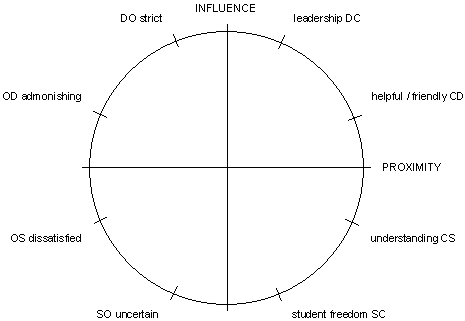
Figure 1: The Model for Interpersonal Teacher Behaviour
The sections are labelled DC, CD, etc. according to their position in the coordinate system described in Figure 1. For example, the two sectors leadership and helpful/friendly are both characterised by Dominance and Cooperation. In the DC sector, the Dominance aspect prevails over the Cooperation aspect. A teacher displaying DC behaviour might be seen by students as enthusiastic, a good leader, and the like. The adjacent CD sector includes behaviours of a more cooperative and less dominant type; the teacher might be described as helpful, friendly.
Research on gender related perceptions found that females at both the primary and secondary levels viewed their teachers as more dominant and more positive(eg. teacher centred) and cooperative than do males (eg. Goh & Fraser, 1995; Rickards & Fisher, 1997; Levy et al., 1992; 2003; Rickards, 1998; Waldrip & Fisher, 1999; Wubbels & Levy, 1993). Despite these consistent patterns, gender related differences with respect to other elements of classroom climate or learning environments research is less conclusive (eg. Dart et al., 1999; Ferguson & Fraser, 1998; Pianta & Nimetz, 1993; Waxman & Huang, 1998).
There is a clear relationship between student ethnicity and their perceptions of teacher communication patterns. Using self designated ethnic group membership as an explanatory variable, investigators found that, in USA samples, Asian-American students perceived less dominance and proximity than students from African-American, Hispanic or Caucasian backgrounds (den Brok, et al., 2002; 2003; Levy, et al., 2003; Levy, Wubbels & Brekelmans, 1996). In a similar vein, Hispanic students felt that their teachers were more dominant and cooperative than other ethnic groups did(den Brok et al., 2002; 2003; Levy et al., 1996). Interestingly, researchers in Australia found that Asian students perceived more influence and proximity and were described as perceiving their classes more positively than students originating from other cultural groups (Evans & Fisher, 2000; Rickards & Fisher, 1997; Rickards, 1998). Of course, apart from differences in methodology (the Australian studies used regular analyses of variance, the American studies multilevel analysis) and sample distribution, the country of interest (USA vs. Australia) may help to explain these surprising differences. Primary home language was also found to be a significant variable in explaining the range of students' views. For example, it was found that those speaking English at home perceived less dominance than students speaking other languages (Levy, Wubbels, Brekelmans & Morganfield, 1997), while those speaking Spanish perceived the most cooperation (den Brok et al., 2003).
In Australian studies, students speaking an Asian language at home were found to rate their teachers higher in terms of influence and proximity (Rickards & Fisher, 1997; Rickards, 1998). Finally, acculturation was found to be of importance: students who have lived longer in the country of interest noticed less dominance than those who had just arrived (Evans & Fisher, 2000, for Australia; Rickards, den Brok & Fisher, 2003, for the USA).
Students' age occasionally has been found to significantly relate to their perceptions of teachers. Levy et al (1997) found that older students noted more teacher dominance than their younger peers, though no effect was found with respect to proximity. A similar effect was found in a later, comprehensive study (Levy, et al., 2003). In still another study (Levy et al., 1992) student age was found to be unrelated to either the influence or proximity dimensions. Students in higher grade levels have reported greater influence and proximity than their younger peers (Ferguson & Fraser, 1998; Levy et al., 1992).
Research investigating the associations between students' achievement and their perceptions of teacher behaviour are also inconclusive, showing significant but weak effects when report card grade is used as an indicator of achievement. Having a standardised set of items for the assessment of achievement has been shown to give more comparable within sample results when compared to inter-school reported class grades (Rickards, 1998). Levy et al. (1992) found that report card grades were positively related to influence and proximity, but the same researchers were not able to replicate this finding in a later study (Levy et al., 1997).
In a recent study, the effect was found to be reversed and was negatively related to influence and proximity (Levy, et al., 2003). Research using cognitive test scores and treating students' perceptions as the independent rather than the dependent variable did find consistent and positive relationships between achievement and influence and proximity (Brekelmans, et al., 2002; Rawnsley & Fisher, 1997; Rickards, 1998). Similar findings applied to affective variables, such as subject related attitudes (Brekelmans, et al., 2002; den Brok, 2001; Rawnsley & Fisher, 1997; Rickards, 1998), although associations usually were investigated in terms of the effect of perceptions of interpersonal behaviour on student (affective) outcomes, but not vice versa (which is the case in the present study).
The more experience that a teacher had, the greater the perception of dominance, leadership and strictness (Levy et al., 1992). While experience was found to positively relate to views on influence, those for proximity - including helpful/friendly or understanding behaviours - remained constant. In other words, students' didn't perceive any increase in cooperative behaviour according to teacher experience (Brekelmans, Holvast & van Tartwijk, 1992; Brekelmans et al., 2002; Somers, Brekelmans & Wubbels, 1997; Wubbels & Brekelmans, 1998; Wubbels & Levy, 1993).
In a number of investigations, teacher ethnic background related to students' views on teacher communication. Asian and Asian-American teachers were perceived as less dominant and cooperative than teachers from other ethnic groups (den Brok et al., 2002; 2003; Levy et al., 1996), while Hispanic teachers were perceived as more dominant and cooperative than their colleagues from other ethnicities (den Brok et al., 2002; Levy et al., 1996).
Class size appeared to be negatively related to students' perceptions of teacher proximity, but was not related to their perceptions of teacher influence (Levy, et al., 2003).
Mixed results have been found for differences in subject taught. While a recent study indicated that students perceived Physics, Science and Mathematics teachers as less understanding and displaying less leadership than teachers from other subjects (Levy, et al., 2003), other studies found them to be more cooperative and dominant (den Brok, 2001; Wubbels & Levy, 1993).
Waldrip and Fisher (1999) investigated differences between students from rural areas (mining students) and students living in the Perth metropolitan area. Mining students had a distinctly different perception of teacher-student interpersonal behaviours. Some of these aspects could be due to the generally more transient nature of mining area students. Rural students were less likely to report the more positive aspects of student-teacher interpersonal behaviours and were more likely to report the negative aspects.
The QTI has a five-point response scale, ranging from "Never/Not at all" to "Always/Very." It is scored on the basis of eight sectors or two summarising dimensions of Influence (or DS) and Proximity (or CO). The Dominance/Submission (DS) dimension is primarily comprised of behaviours in the sectors closest to the DS axis - strict, leadership, uncertainty and student responsibility/freedom. The sectors that mostly make up the Cooperation/Opposition (CO) dimension are helpful/friendly, understanding, dissatisfied and admonishing. In Table 1 typical items are provided for each of the eight sectors of the QTI.
Table 1: Typical items of the English version of the QTI
| Scale (sector) | Typical item |
| DC - leadership | This teacher acts confidently. |
| CD - helpful/ friendly | This teacher is friendly. |
| CS - understanding | This teacher is patient. |
| SC - student responsibility/freedom | We can influence this teacher. |
| SO - uncertain | This teacher is hesitant. |
| OS - dissatisfied | This teacher is suspicious. |
| OD - admonishing | This teacher gets angry quickly. |
| DO - strict | This teacher is strict. |
The QTI has acceptable reliability and validity when used in grades 7 to 12 (Wubbels & Levy, 1993, Rickards, 1998). A recent review on the validity and reliability of over 20 studies that have used the QTI during the last 17 years (den Brok, 2001) showed that reliability of the eight scales (sectors) is sufficient and consistent across classes. Moreover, the review showed that the theoretical structure of the Model for
Interpersonal Teacher Behaviour was represented in the items and scales of the instrument. While the QTI has been repeatedly judged to be an acceptable instrument for use in teacher research and professional development, it is nearly 20 years old. It was therefore important to re-examine whether the instrument still reflected acceptable reliability and validity. This study conducted reliability and discriminant validity analyses for the eight scales of the QTI. Table 2 provides reliability and percentages of variance at the class level for each of the scales of the QTI. As can be seen in Table 2, the instrument was found to be reliable and able to discriminate between classes.
Construct validity was investigated in a number of ways. First, an exploratory factor analysis was conducted on the (aggregated) scale scores in order to see if two dimensions were present in the data (see den Brok, Fisher, et al., submitted; Rickards, den Brok & Fisher, 2003).
Table 2: Reliability (alpha) of QTI scales at the student and
class level, and variance at the class level (eta-squared)
| Scale | alpha Student level | alpha Class level | ETA |
| DC - leadership | .82 | .93 | .33 |
| CD - helpful/friendly | .88 | .96 | .35 |
| CS - understanding | .85 | .95 | .32 |
| SC - student responsibility/ freedom | .66 | .82 | .26 |
| SO - uncertain | .72 | .87 | .22 |
| OS - dissatisfied | .80 | .93 | .23 |
| OD - admonishing | .76 | .87 | .31 |
| DO - strict | .63 | .78 | .23 |
This analysis indicated that two factors with an eigenvalue larger than one could be extracted, explaining 79 percent of the variance. Inspection of the factor loadings suggested two dimensions that could be labelled in terms of influence and proximity.
Table 3: Variables used in multilevel analysis
| Level | Variable | Description |
| Student | Gender | Dummy variable with boys indicated by a '1'. |
| Attitude | Scale variable (recoded to a score between 0 and 1) indicating the motivation for class. | |
| Achievement | Scale variable indicating recent test score, ranging between 0 and 100 (percentage score). | |
| Language spoken at home | Students indicate which language is spoken at home most of the time. Recoded into dummy variable with '1' indicating English. | |
| Mother's country of birth | Students indicate where their mother was born. Recoded into a series of dummy variables (Europe, Asia, South-East Asia, Oceania, Africa, North America, South America), with a '1' indicating the specific country (Australia is baseline). | |
| Class | Subject taught | Series of dummy variables indicating subject taught (Science, Math, Other subjects), with a '1' i ndicating a category hit. |
| Grade level | Variable indicating the grade level, ranging between 8 to 12, recoded into a variable running from 1 to 6, with a higher score indicating a higher grade level. | |
| Class size | The number of students in the class. | |
| Percentage boys | Variable indicating the ratio of boys in class (between 0 and 1). | |
| Percentage English | Variable indicating the ratio of students in class speaking English at home most of the time (between 0 and 1). | |
| Percentage Australian | Variable indicating the ratio of students in class with their mother born in Australia (between 0 and 1). | |
| Class achievement | Class average of achievement. | |
| Class attitude | Class average of attitude. | |
| School | Type | Dummy variable indicating if a school is independent ('1') or not. |
| State | Dummy variable indicating the state of location of the school (with a '1' indicating Tasmania). |
Second, correlations were computed between scales at the class level. This correlation matrix was then investigated for its circular structure by computing a Correspondence Index (with the RANDALL software; Tracey, 1994; Tracey & Schneider, 1995). The correspondence index indicates to what degree and with what probability a correlation matrix corresponds to a circumplex structure. If a circumplex model applies to the data, correlations should be highly positive for neighbouring scales, dropping until they become highly negative with scales on the opposite end, opposing scales, of the interpersonal circle (Gurtman & Pincus, 2000).
CI for the correlation matrix was .72 (p=.0008), indicating that a circular ordering applied to the scales of the QTI for the present sample. Third, a correlation between the two dimension scores was computed. For the current sample, the correlation was .24 (p=.001), indicating some association between the two dimensions. Inspection of the plot of factor loadings, based on the factor analysis, suggested that the correlation could have been caused by two scales occupying different positions on the interpersonal circle than hypothesised: understanding (CS), had moved counter-clockwise and changed places with the helpful/friendly (CD) sector, while dissatisfied (OS) had moved clockwise and almost overlapped with admonishing (OD). Despite these (minor) irregularities, given the high CI and outcomes of the factor analysis (and prior validity outcomes on an even larger Australian data set including the present one, eg. Rickards, den Brok & Fisher, 2003), the researchers conducting this study decided to use the QTI based dimension scores.
In addition to students' perceptions of teacher interpersonal behaviour, several other student, class and school variables were investigated (see Table 3 for an overview of these variables). Students' ethnic background was measured in terms of a number of variables: language spoken at home most of the time (English or other), country of birth of the mother (Australia, Europe, Asia, South-East Asia, Oceania, Africa, Northern America and Southern America) and country of birth of the father (similar distinction). It was decided to only use country of origin for the mother. The language and ethnic membership data were recoded into sets of dummy variables for the multilevel analyses. The student ethnicity data were also used to create a number of class related ethnicity variables.
For each class, the percentage of English speaking students was determined, as well as the percentage of students with an Australian born mother. Apart from ethnicity, students were asked to provide information regarding their gender, a recent achievement test and their attitude towards the teachers' lessons (using the TOSRA, a Test Of Science Related Attitudes; Fraser, 1981; Fisher, Henderson & Fraser, 1995, Rickards, 1998). Class mean equivalents for these variables were also calculated, as it was assumed that the level of the class might also affect students' perceptions.
At the class level, the following variables were created: class size (number of students in class), grade level, percentage of male students and subject taught. 'Subject taught' was divided into a number of dummy variables (indicating Math, Science or Other subjects). With respect to the school, information was gathered on the type of school (government or independent) and state (Tasmania or Western Australia).
In terms of class composition variables, the sample was quite diverse. The average percentage of boys in the class was .50, but classes ranged from girls only to boys only. Most of the classes consisted of mainly English speaking students, with a percentage range of English speaking students between 50 and 100. Class size ranged from 5 to 35, with an average class size of 24.
Achievement scores ranged between 3 and 97 percent (mean 62 percent, standard deviation 19.8 percent), attitude ranged between 0 and 1 (mean attitude was .60, standard deviation .20).
Table 4: Mean DS and CO scores and percentages of variance
at the school, class and student level (empty model)
| Influence (DS) | Proximity (CO) | |
| Constant/mean (st. error) | .48 (.02) | .71 (.03) |
| Variance - School - Class - Student | 0.0 % 30.1 % 69.9 % | 1.5 % 28.3 % 70.2 % |
| -2*Loglikelihood | 2778.46 | 6707.47 |
As can be seen, on average, Australian secondary school teachers were regarded as both dominant and cooperative (note that DS and CO scores can range between -3 and +3). Also, two-thirds of the variance was located at the student level, with only minimal variance at the school level and the remainder of the variance at the class (or teacher) level. These findings are in line with studies using multilevel analyses on American data (den Brok, et al., 2002; Levy, et al., 1997; 2003). They suggest that a school can hardly be recognised by its 'interpersonal' profile.
Table 5: Variables explaining students' DS and CO perceptions
| Influence (DS) | Proximity (CO) | |||
| Coefficients (st. error) | Effect size | Coefficients (st. error) | Effect size | |
| Constant | -.69 (.28) | - | -1.24 (.11) | - |
| Student - attitude - gender - language at home - Mother born in SE-Asia Class - Math - Other subjects - Percentage boys - Percentage English-sp. - Percentage Australian - Class attitude - Class size School |
.33 (.03) -.05 (.01) .06 (.02) .06 (.5) - - - .87 (.29) -.22 (.10) .31 (.16) .004 (.002) | .168 -.058 .033 .030 - - - .141 -.108 .073 .074 | 1.72 (.04) -.10 (.01) .09 (.03) - .10 (.05) .22 (.06) -.17 (.08) - - 1.59 (.17) - | .545 -.082 .030 - .056 .077 -.048 - - .230 - |
| Variance -- explained -- school -- class -- student |
6.5 % 0.0 % 26.5 % 67.0 % |
52.7 % 1.5 % 6.5 % 39.3 % | ||
| -2*Loglikelihood | 2598.21 | 4766.93 | ||
Differences in perceptions were also reported with respect to ethnicity related variables. Students speaking mainly English at home perceived their teachers as more dominant and more cooperative. As with gender and attitude, this finding supports earlier outcomes (den Brok, et al., 2003; Levy, et al., 1997; 2003). Also, students whose mother was born in South-East Asian countries reported higher perceptions of influence than students whose mother was born in Australia or any of the other countries.
For proximity, no differences were found with respect to country of origin of the mother. While earlier analyses on the same data set indicated similar findings for influence related scales (Rickards & Fisher, 1997; Rickards, 1998), the absence of a relationship between ethnicity and proximity was different. It seems very likely that the analysis method used has contributed to this difference: apparently, when taking into account the fact that the data was not sampled randomly and when correcting the effect of ethnicity for other variables (in this case: gender, attitude and several class variables), the effect of ethnicity reduces and becomes non-significant.
At the class level, it was found that teachers from other subjects than Science were perceived as more cooperative, but that no difference existed with respect to dominance. This adds to the mixed findings in earlier work, showing no consistent differences over studies. Class gender composition only had an effect on proximity: the more boys in the class, the less proximity was perceived. This finding supports that of an earlier study by Levy and colleagues (2003).
Ethnic makeup of the class also appeared to be relevant: the more English speaking students in the class, the more dominant the teacher was perceived. This resembles outcomes at the student level. Also, the fewer students with Australian born mothers, the more influence was perceived. Again, findings resembled those of the student level.
Class attitude had a positive effect on both influence and proximity: students in highly motivated classes had a more favourable perception of their teacher.
Finally, class size only had an effect on influence: the larger the class, the less dominant the teacher was perceived. Earlier studies only found an association between proximity and class size (eg. Levy, et al., 1992; 2003). No school level variables were found to be associated to students' perceptions. Similarly, no interaction effects were found.
Combined, the variables only explained a relatively small amount of variance (6.5 percent) in influence. This percentage is similar to that of earlier studies (eg. Levy, et al., 2003) and suggests that other variables may be necessary in order to explain differences in perceptions between students and their classes. The model explained up to 11 percent of the variance at the class level, but only 7 percent of the variance at the student level.
A large amount of variance - more than half of it - was explained for proximity. This is a unique and surprising finding, as - usually - similar amounts of variance are explained in influence and proximity. The model explained nearly all variance at the class level and about 30 percent of the variance at the class level. This is a very satisfying finding and adds value to this study as a source of validation for other studies.
However, it should be noted that the study also differed from earlier work in a number of ways. Firstly, this study was amongst the first to investigate the effect of student and class attitude on students' perceptions. This variable proved to be of major influence and suggests researchers to include it in future investigations. The findings with respect to attitude also point at the mutual effect that motivation and perception have on each other, which supports the system oriented nature of communication in the classroom (Watzlawick, Beavin & Jackson, 1967).
Secondly, the study found an effect of class size on the perception of influence, while earlier studies only reported effects on proximity. While the finding supports expectations - teachers need to be more strict and strong leaders to establish structure and order in a larger class - future research is needed to confirm its importance for influence.
Thirdly, this study managed to explain large amounts of variance in ratings of proximity. On the one hand, this might have been caused by the inclusion of subject related attitude into the models. On the other hand, the finding is unique in studies using multilevel analyses on QTI scale or dimension scores, and might be related to sample characteristics or context. Future research is needed to also confirm the stability of this finding.
Unfortunately, the study was subject to some limitations. First, since most teachers participated with only one class (some participated with more classes), we were not able to distinguish between the teacher and class level. While expectations are that adding an extra level to the analyses would have altered the results only slightly, it might have showed some interesting findings with respect to stability of perceptions across classes of the same teacher. Secondly, in the models used in this study, no teacher variables such as experience, gender and ethnic background were included. Earlier research using the QTI has shown that these variables are also related to students' perceptions, and including them in the analyses may have provided even higher amounts of explained variance. Thirdly, there was a slight concern regarding validity of the QTI in this sample. While prior research showed the Australian QTI version to display adequate construct validity (den Brok, Fisher, et al., submitted; Rickards, et al., 2003), in this study some association was found between the two dimensions, probably as a result of dislocation of the CS (understanding) and OD (admonishing) scales. It remains unknown to what extent these irregularities may exert an influence on the outcomes.
Finally, the study only used quantitative (questionnaire) data. While such data enables researchers to describe and investigate more broad and comprehensive trends, it fails to explain in depth why these patterns are found, or how they may be caused. In the research from which this data set originated (eg. Rickards & Fisher, 1997; Rickards, 1998) qualitative data was gathered by means of interviews with teachers and students. However, the interviewing was intended to support construct validity, rather than search for causal relationships with student or class characteristics.
The findings are significant for both researchers and teachers or policy makers. The results indicate that perceptions of the teacher may vary as a result of class size, ethnic composition and gender composition. Since students' perceptions of their teachers' interpersonal behaviour are strongly related to their achievement and motivation, the outcomes of this study suggest that, in order to obtain favourable perceptions (hence: student outcomes) of the classroom environment from all students, it is probably best to evenly distribute students in terms of characteristics such as gender and ethnicity. Also, of teachers it is important to realise that students from different backgrounds or gender perceive them differently. Knowledge of such differentiated perceptions may help teachers in establishing teaching methods that affirm all students (eg. Nieto, 1996). For researchers, this study clearly shows the importance of student and class attitude in predicting students' perceptions of their learning environment and serves as a valuable comparative study for future research.
Brekelmans, M., Holvast, A., & van Tartwijk, J. (1992). Changes in teacher communication styles during the professional career. The Journal of Classroom Interaction, 27, 13-22.
Brekelmans, M., Wubbels, Th., & Brok, P. den (2002). Teacher experience and the teacher-student relationship in the classroom environment. In S. C. Goh & M. S. Khine (Eds.), Studies in educational learning environments: An international perspective (pp.73-100). Singapore: New World Scientific.
Brok, P. den (2001). Teaching and student outcomes. Utrecht, the Netherlands: W. C. C.
Brok, P. den, Fisher, D. L., Brekelmans, M., Rickards, T., & Wubbels, T. (submitted). Secondary science teachers' interpersonal style in five countries: a cross-national study. Paper submitted to Learning Environments Research.
Brok, P. den, Levy, J., Rodriguez, R., & Wubbels, T. (2002). Perceptions of Asian-American and Hispanic-American teachers and their students on interpersonal communication style. Teaching and Teacher Education, 18, 447-467.
Brok, P. den, Levy, J., Wubbels, T., & Rodriguez, M. (2003). Cultural influences on students' perceptions of videotaped lessons. International Journal of Intercultural Relations, 27(3), 355-374.
Brown, R. (1965). Social psychology. London: Collier-MacMillan.
Dart B., Burnett, P., Boulton-Lewis, G., Campbell, J., Smith, D., & McCrindle, A. (1999). Classroom environment and students' approaches to learning. Learning Environments Research, 2, 137-156.
Dunkin, M. J., & Biddle, B. J. (1974). The study of teaching. New York: Rhinehart & Winston.
Evans, H., & Fisher, D. L. (2000). Cultural differences in students' perceptions of science teachers' interpersonal behaviour. Australian Science Teachers Journal, 46 (2), 9-18.
Fabrigar, L. R., Visser, P. S., & Browne, M. W. (1997). Conceptual and methodological issues in testing the circumplex structure of data in personality and social psychology. Personality and Social Psychology Review, 1, 184-203.
Ferguson, P. D., & Fraser, B. J. (1998). Changing in learning environment during the transition from primary to secondary school. Learning Environments Research, 1, 369-383.
Fisher, D.L., Fraser, B.J., & Rickards, T.W. (1997). Gender and cultural differences in teacher-student interpersonal behavior. Paper presented at the Annual Meeting of the American Education Research Association, Chicago.
Fisher, D., Fraser, B., & Wubbels, T. (1993). Associations between school learning environment and teacher interpersonal behavior in the classroom. In T. Wubbels & J. Levy (Eds.), Do you know what you look like? (pp.103 -112). London: The Falmer Press.
Fisher, D., Henderson, D., & Fraser, B. (1995). Interpersonal behavior in senior high school biology classes. Research in Science Education, 25, 125-133.
Fisher, D. L., & Rickards, T. (2000). Teacher-student interpersonal behaviour as perceived by Science teachers and their students. In D. Fisher & J. Yang (Eds.), Improving classroom research through international cooperation (pp.391-398). Taiwan: National Taiwan Normal University.
Foa, U.G. (1961). Convergence in the analysis of the structure of interpersonal behavior. Psychological Review, 68, 341-353.
Fraser, B.J. (1981). TOSRA: Test of Science-Related Attitudes Handbook. Hawthorn: The Australian Council for Educational Research Limited.
Gaines, S. O., Panter, A. T., Lyde, M. D., Steers, W. N., Rusbult, C. E., Cox, C. L., & Wexler, M. O. (1997). Evaluating the circumplexity of interpersonal traits and the manifestation of interpersonal traits in interpersonal trust. Journal of Personality and Social Psychology, 73, 610-623.
Goh, S. C., & Fraser, B. J. (1995). Learning environment and student outcomes in primary mathematics classrooms in Singapore. Paper presenting at the annual meeting of AERA, San Francisco.
Goldstein, H. (1995). Multilevel statistical models. London: Edward Arnold.
Gurtman, M. B., & Pincus, A. L. (2000). Interpersonal adjective scales: confirmation of circumplex structure from multiple perspectives. Personality and Social Psychology Bulletin, 26, 374-384.
Henderson, D. G. (1995). A study of the classroom and laboratory environments and student attitude and achievement in senior secondary Biology classes. Unpublished doctoral dissertation, Curtin University of Technology, Perth, Australia.
Hox, J.J. (1995). Applied multilevel analysis. Amsterdam: TT Publicaties.
Leary, T. (1957). An interpersonal diagnosis of personality. New York: Ronald Press Company.
Levy, J., den Brok, P., Wubbels, T., & Brekelmans, M. (2003). Students' perceptions of interpersonal aspects of the learning environment. Learning Environments Research, 6, 5-36.
Levy, J., Wubbels, T., Brekelmans, M., & Morganfield, B. (1997). Language and cultural factors in students' perceptions of teacher communication style. International Journal of Intercultural Relationships, 21, 1, 29-56.
Levy, J., Wubbels, Th., & Brekelmans, M. (1996). Cultural factors in students' and teachers' perceptions of the learning environment. Paper presented at the annual meeting of the American Educational Research Association, San Francisco.
Levy, J., Wubbels, Th., & Brekelmans, M. (1992). Student and teacher characteristics and perceptions of teacher communication style. Journal of Classroom Interaction, 27, 23-29.
Lonner, W.J. (1980). The search for psychological universals. In H.C. Triandis & W.W. Lambert (Eds.), Handbook of cross cultural psychology (vol.1) (pp. 143-204). Boston: Allyn and Bacon.
Luyten, H., & De Jong, R. (1998). Parallel classes: differences and similarities. Teacher effects and school effects in secondary schools. School Effectiveness and School Improvement, 9(4), 437-473.
Muthén, B. (1994). Multilevel covariance structure analysis. Sociological Methods & Research, 22, 338-354.
Nieto, S. (1996). Affirming diversity: The sociopolitical context of multicultural education. New York: Longman.
Pianta, R., & Nimetz, S. L. (1993). The student-teacher relationship scale: Results of a pilot study (research reports). Harrison, VA: James Madison University. (ERIC Document Reproduction Service No. Ed. 308961)
Rawnsley, D. & Fisher, D. L. (1997). Using personal and class forms of a learning environment questionnaire in mathematics classrooms. Paper presented at the International Conference on Science, Mathematics & Technology Education, Hanoi, Vietnam.
Rickards, T. (1998). The relationship of teacher-student interpersonal behavior with student sex, cultural background and student outcomes. Unpublished doctoral dissertation, Curtin University of Technology, Perth, Australia.
Rickards, T., den Brok, P. and Fisher, D. (2003). What does the Australian teacher look like? Australian typologies for teacher-student interpersonal behaviour. Proceedings Western Australian Institute for Educational Research Forum 2003. http://www.waier.org.au/forums/2003/rickards-2.html
Rickards, T., & Fisher, D. L. (1997). A report of research into student attitude and teacher student interpersonal behaviour in a large sample of Australian secondary mathematics classrooms. Paper presented at the annual meeting of the Mathematics Education Research Group of Australia, Rotorua, New Zealand.
Slater, P. E. (1962). Parental behavior and the personality of the child. Journal of Genetical Psychology, 101, 53-68.
Somers, T., Brekelmans, M., & Wubbels, Th. (1997). Development of student teachers on the teacher-pupil relationship in the classroom. Paper presented at the bi-annual meeting of the European Association of Research on Learning and Instruction, Athens, Greece, August.
Strack, S. (1996). Special series: Interpersonal theory and the interpersonal circumplex: Timothy Leary's Legacy, Journal of Personality Assessment, 66, 211-307.
Tracey, T. J. (1994). An examination of complementarity of interpersonal behavior. Journal of Personality and Social Psychology, 67, 864-878.
Tracey, T. J., & Schneider, P. L. (1995). An evaluation of the circular structure of the checklist of interpersonal transactions and the checklist of psychotherapy transactions. Journal of Counseling Psychology, 42, 496-507.
Veenman, S. (1984). Problems of beginning teachers. Review of Educational Research, 54, 143-178.
Waldrip, B. G., & Fisher, D. L. (1999). Differences in country and metropolitan students' perceptions of teacher-student interactions and classroom learning environments. Paper presented at the annual meeting of the Australian Association for Research in Education, Melbourne. http://www.aare.edu.au/99pap/wal99002.htm
Watzlawick, P., Beavin, J. H., & Jackson, D. (1967). The pragmatics of human communication. New York: Norton.
Waxman, H. C., & Huang, S. L. (1998). Classroom learning environments in urban elementary, middle and high schools. Learning Environments Research, 1, 95-113.
Wubbels, Th., & Brekelmans, M. (1998). The teacher factor in the social climate of the classroom. In B. J. Fraser, & K. G. Tobin (Eds.), International Handbook of Science Education (pp.565-580). London: Kluwer Academic Publishers.
Wubbels, T., Brekelmans, M., & Hermans, J. (1987). Teacher behavior: an important aspect of the learning environment. In B. J. Fraser (Ed.), The study of learning environments 3 (pp.10-25). Perth: Curtin University.
Wubbels, T., Créton, H.A, & Hooymayers, H.P. (1985). Discipline problems of beginning teachers, interactional behavior mapped out. Paper presented at the American Educational Research Association annual meeting, Chicago. Abstracted in Resources in Education, 20(12), 153, ERIC document 260040.
Wubbels, T., Créton, H.A, & Hooymayers, H.P. (1987). A school-based teacher induction programme. European Journal of Teacher Education, 10, 81-94.
Wubbels, T., & Levy, J. (1991). A comparison of interpersonal behavior of Dutch and American teachers. International Journal of Intercultural Relations, 15, 1-18.
Wubbels, T., & Levy, J. (1993). Do you know what you look like? London: The Falmer Press.
| Contact person: t.rickards@curtin.edu.au
Please cite as: Rickards, T. and den Brok, P. (2003). Factors influencing students' perceptions of their teachers' interpersonal behaviour: A multilevel analysis. Proceedings Wes tern Australian Institute for Educational Research Forum 2003. http://www.waier.org.au/forums/2003/rickards-3.html |