Research into the effectiveness of online learning in higher education: Survey findings
Lou SiragusaCurtin University of Technology

[ Proceedings Contents ] [ Schedule ] [ Abstracts ] [ WAIER Home ]
Research into the effectiveness of online learning in higher education: Survey findingsLou SiragusaCurtin University of Technology |
|
With the use of online learning environments firmly integrated into many higher education courses, the effectiveness of this mode of delivery has come under question and has been the subject of various studies in this area. This paper presents an ongoing research study seeking effective instructional design principles for the online learning environment in higher education. A survey was administered to students and their lecturers studying in various courses throughout the major universities in Western Australia who are using online learning environments. The survey utilised both quantitative and qualitative methods for collecting data including questionnaires and interviews. The student survey involved over 250 students who responded to an online questionnaire and 25 students who were interviewed. The survey focused on elements of online learning including content, structure, motivation, feedback, interaction and learning strategies. Among the findings, many students indicated that they were generally satisfied with using online learning support for the units they were studying, but are often disappointed with the way in which it is being used in some of the courses.
The vast body of literature referring to instructional design models theories and models has been largely overlooked by designers of online learning environments. Although implementing online learning technologies is relatively easy, creating educationally effective and useful websites is still difficult (Pan, 1998). As online learning technologies continue to develop, it is more important to consider the use of effective instructional design principles for this environment (Chen, 1998). The way in which people read an HTML page on the computer screen is different from the way they read word processed documents on printed paper. Over recent years, authors have been documenting these differences and have acknowledged the need for further investigation into instructional design for Internet delivery. Greening (1998), for example, argued that "...generally, instructional designers either do not always appear to take advantage of the hypermedia technology, or do so without pedagogical foundation." Decisions made at the instructional design phase of course development can influence and encourage different learning strategies that can be used by students (Bull, Kimball, & Stansberry, 1998, pp. 40-41; McLoughlin & Oliver, 1998; Smith & Ragan, 1999, pp. 138, 233-4).
This paper will describe a study currently in progress aimed at identifying effective instructional design principles and learning strategies for web-based learning environments in higher education. This study involved the administration of a survey to students and their lecturers studying in a number of units throughout the five universities in Western Australia who are using web-based learning environments. This paper will report on the preliminary analysis of the student survey.
Researchers have identified various approaches students have demonstrated towards a learning task including deep approach (obtain a deeper understanding of the content), surface approach (memorise facts and complete assessment tasks without a deep understanding of the content) and strategic approach (an alertness to marking schemes to obtain the highest possible grades) (Entwistle, 1987, p. 60). Student are capable of varying their approach to a learning task according to their interpretation of the demands of the learning situation (Laurillard, 1993, p. 32). Research has demonstrated, however, that students should be encouraged to adopt a deep approach towards the learning tasks they encounter for effective learning to take place (e.g., Biggs, 1987; Biggs, 1999; Entwistle, Hanley, & Hounsell, 1979; Entwistle, 1987; Laurillard, 1993). A number of models have been put forward to describe ways in which instruction can be designed to encourage students to adopt a deep approach to learning tasks such as the Presage, Process, Product (3P) model of student learning (Biggs, 1999, p. 18). The 3P model takes into account interrelated features of the learning experience which include: student factors (prior knowledge, ability, motivation), the teaching context (objectives, assessment, teaching), learning focused activities (appropriate deep approaches), and learning outcomes (facts, skills, transfer). Designers of instruction need to consider such models of student learning when designing for higher education courses regardless of the delivery medium.
Online learning has undoubtedly altered the way courses are being delivered in many universities. The Internet is being used in a variety of ways from supporting traditional face-to-face delivered classes to the complete delivery of instruction over the web. However, we are only just beginning to explore the possibilities of online learning and coming to recognise its strengths and limitations (Ryan et al., 2000, p. 28). It is clear that that online learning technologies does not provide the complete cost-effective solutions once hoped for by earlier advocators of the use of this medium for learning. If students are expected to experience successful learning through the use of the Internet, as with the use of any other medium, the design of instruction must consider the learners' needs and how the learning will interact with this environment.
From the literature composed of discussions and research findings concerning the three main discipline areas acknowledged above, there are six distinct focus areas which have been identified as having direct influence on the design of effective online learning environments. These six focus areas have been categorised as: Structure, Content, Motivation, Feedback/Help, Interaction, and Learning Strategies. This has been illustrated in Figure 1.

Figure 1: A model showing focus areas relating to online
learning in higher education identified in the literature.
Although it is not possible to include all of the literature discussions within these focus areas in this paper, the following will provide a summary of some of the findings within these focus areas which have contributed to the development of this study. The findings within these focus areas have contributed to the formation of dimensions (and scales) for the survey instruments used in this study.

Figure 2: Summary of the research design
The questions were designed to solicit students' perception (affective) of how well instructional design principles had been applied to their online learning environment. A separate questionnaire was prepared for the lecturers (although the findings of this questionnaire will not be reported in this paper). The majority of the questions in the questionnaire were written in a five-point Likert-scale style format. The questionnaires also contained a combination of factual questions and open ended questions. The questionnaires for the students was administered using an online questionnaire form, which submitted the results electronically to the researcher. After completing the questions, the respondents clicked on the Submit button allowing the responses to be emailed to the researcher. The responses were then automatically sorted into an Excel worksheet ready for analysis. The questions in the semi-structured interviews were similar to those given in the questionnaire; ho wever, the respondents were allowed to expand upon their answers if they wished. Table 1 displays the dimensions used for the questionnaire and interview schedule which were administered to the students. Table 2 provides a sample of some of the questions within each of the dimensions.
| Dimension | Description |
| Structure/ organization | This described how the information was displayed to students on the web. |
| Content | This described the content of the learning materials that students worked through. Content included the subject/course content, assignments, activities, case studies, lecturer/tutorial/laboratory notes, reading materials, tests, etc. |
| Motivation | This described how the learning materials and the online learning environment were made appealing and interesting for students. |
| Feedback/help | This described how students obtained coursework feedback and technical help. |
| Interaction | This described how students communicated with each other and with their instructor. |
| Learning strategies | This described what learning strategies instructors encouraged students to use and what learning strategies students found effective. |
| Dimension | Sample question items |
| Structure/ organization | The class web site was interesting and pleasant to use. (+) I needed to constantly jump from page to page to find what I was looking for. (-) |
| Content | The content was organised in an appropriate sequence. (+) The content covered all essential information (both theory and practical). (+) |
| Motivation | The material that was presented on the class web site was interesting and meaningful to me. (+) Online learning provided me with flexibility such as being able to study when it was convenient to me. (+) |
| Feedback/help | There were clear instructions on how to submit assignments. (+) I received prompt feedback from my lecturer/tutor about my assignments. (+) |
| Interaction | I found the online discussions with my lecturer/tutor and other class members valuable. (+) The interactions that I had with my lecturer/tutor affected the outcomes of my assignments. (+) |
| Learning strategies | I took more responsibility for my own learning working in a class with an online component. (+) I was able to share with other students in this class what it was that I did not understand. (+) |
| University | Department/School/Faculty |
| Curtin University of Technology | Faculty of Education Science and Mathematics Education Centre School of Physiotherapy School of Media and Information |
| Edith Cowan University (Churchlands) | Faculty of Business and Public Management |
| Murdoch University | School of Education School of Environmental Science |
| University of Notre Dame Australia | School of Business |
| University of Western Australia | Faculty of Engineering, Computing and Mathematics Department of Science |
From these departments, 252 students completed the online questionnaire. From these 252 students, 25 students participated in a semi-structured interview.
The preliminary analysis of the survey data focused on the main areas identified in the research questions.
| Scale | Reliability (coefficient alpha) | No. of scale items | Range of means | |
| Lowest mean | Highest mean | |||
| Structure/ organisation | 0.74 | 6 | 3.42 | 3.83 |
| Content | 0.78 | 8 | 3.31 | 4.31 |
| Motivation | 0.75 | 7 | 3.29 | 4.08 |
| Feedback/ help | 0.79 | 8 | 3.11 | 3.90 |
| Interaction | 0.73 | 5 | 3.38 | 3.62 |
| Learning strategies | 0.73 | 7 | 2.81 | 3.69 |
Nelson (2001, p. 140) put forward Kaplan and Sacuzzo (1993) as having stated: "It has been suggested that reliability estimates in the range of .70 and .80 are good enough for most purposes in basic research" (p. 126). Therefore, the alpha values will be considered acceptable for the purposes of this study.
Table 4 also reports the range of means for each scale from lowest to highest. Figure 3 displays a sample of typical histograms showing student questionnaire responses from each scale. From the range of means and the sample of histograms, it can be seen that students appear to be mostly selecting the Agree (4) option in response to the affective questions. Although this may indicated that the majority of students are satisfied with the online learning environments they are using, there appears to be a reluctance to strongly agree with the affective statements presented in the questionnaire. As the majority of students appear not to be entirely satisfied with web-based learning, this may indicate areas of weakness within these environments needing further investigation.
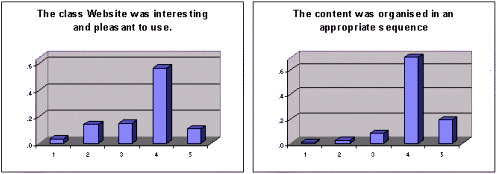 | |
| Structure/Organisation | Content |
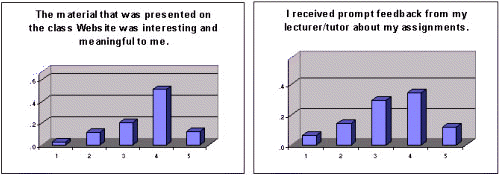 | |
| Motivation | Feedback |
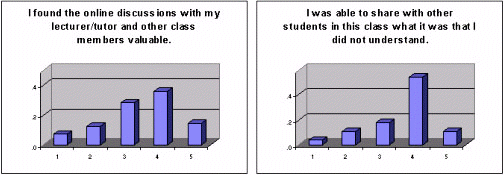 | |
| Interaction | Learning strategies |

Figure 4: Histograms of learning strategies used by students with online learning
The qualitative data collected soundly confirmed the quantitative findings. The students appeared to be generally satisfied with using an online learning environment, even if it is just used to support face-to-face teaching. However, the students have identified areas of weakness with the way in which online learning environments were being used.
Although an interview schedule was prepared using the same dimensions as for the online questionnaire, students were encouraged to discuss any concerns they wish regarding the online learning environment they used for that semester. The way in which students responded to the interview questions varied. Some students were particularly keen to express problems they had encountered and some were enthusiastic to offer suggestions for improvements. For example, when students were asked questions such as, 'Where you happy with the way in which the material was presented on the web site?' a typical response was "Yes" to these types of questions. However, some students did make meaningfully critical comments regarding their satisfaction with the online learning environment. The following presents examples of comments made by students in response to the questions within each of the survey dimensions.
"Um, there was a mixture of stuff on there. Um, I think it could have been better organised."Some students were able to make adjustments to the way in which the material was presented on the website by reformatting it to suit their requirements."I'm quite experienced with using the web. I did spent a fair bit of time with peculiarities of the WebCT ... like pages that, um, hang for a time that you click to go to them and so you got to back out and go in a second time, sort of quite bizarre programming."
"... I went into the WebCT and copied it out, and plonked it into my work, and then I start doing my assignments from there, by reformatting it. I'm very skilled with computing side of it, so I don't think I have any problems what so ever."
"Yeah, subject content was fine, ... we just had lecturers and went to manual tutorial classes and none of the notes from that lecture were put on the web or anything. You had to actually go to the lecture. If you missed the lecture [you had] to go to the lecture and copy the notes, and that was frustrating ... as a mature age student, because if you missed one lecture then I could not do the tute properly for that week because you need the notes because there was no text book."Other students needed to have access to content materials that would support assessment activities which were also online.
"I think basically to just give out ... more information on the unit and more practical questions ... I wish they had you know more than just five to practice."
"...Um, but I [was] sort of clicking through these links to see why they have been put there, and um, I found some stuff that was not just very interesting but I found it very relevant to a lot of the questions that we have been discussing in the workshops."Students were also asked if their online lecturer showed concern for the students' progress and if the lecturer's interest stimulated their interest for the unit.
"Yes, in a way because anytime when I had problems then I would email her and then she would come back to me with the reply."Prompt replies to email messages was shown to be encouraging for students' progress throughout the unit.
"So, I don't think they had anything like, um, you know frequently ask questions with solutions to common problems people might have... I don't think there was much there, but um, I don't know how much [help] would be needed... I think it would probably would be helpful. A good thing to have a lot more on help online because ... I have a picture that quite a lot of students were actually using it [WebCT] less than they might because of lack of familiarity. So, if they found some nice pages there that explained a lot of things in a straight forward terms, then that could have been valuable."Students were asked to comment on the promptness and effectiveness of the feedback they received from their online lecturer. Overall, students appeared to be quite happy with feedback regarding assignments. Some students were using an online assignment submission application and commented on its effectiveness.
"... submitting assignments online, you don't actually get an email back ... saying 'yeah we have got your assignment', ... you are not sure whether the lecturer did get the assignment, you don't actually get a response, you need to get a direct response ..., and that was a little bit, um, disappointing because I wasn't sure whether they had received my assignment..."One student commented on how working in groups and receiving feedback from other students regarding their assignments was helpful. This also helped to increase motivation to succeed in the unit.
"... when my fellow students had some problem and I thought, 'oh, I'm not the only one' and you know we say 'OK, what do we do about it', and there was a learning lab system so we decided to go there."
"I preferred email because, um, I like checking my friends assignments and they check mine. You know what I mean. A single checking is not plagiarism or anything like that."Students were asked if they wished there were more online discussions. Some were happy not to participate in online discussions, although they may have sent out the occasional email. Other students wanted more online discussions.
"Um, yeah. I would want that because the more you discuss maybe you might find you know better solutions and you get other peoples opinion I think that would be very good."
"Um, we were doing the problems over the website..., yes but I mean they had the answers on there and you lost two marks, two out of ten for every time you did it incorrectly and you had practise questions..."Many students were encouraged to work in groups, particularly if they were to work on case studies and problem solving activities.
"We worked in groups, ... we were meant to meet each other but really we didn't as a group, we really only emailed each other, divided up the course work and then put it together, we integrated it all. So I mean it didn't work, so I don't know, in a way its negative, because it allows you to have direct communication so you're not going to have group meetings, you are not going to see each other in person, but in a way for the students its so much better because there is no point in meeting each other, it is much better to divide the contents up into sections, divide it up and do it."Students often searched the Internet to assist them with the completion of assignments and presentations.
"Assignment and the work, assignments mainly. You had to go online and get information from other sites, analyse other sites..."Some students commented on how they believed using the Internet for learning allowed them to take more responsibility for their own learning.
"... because some lectures are very repetitive and ... this helped me sort of take control of my own learning and have it at my own pace."
"It was good because we had the flexibility to do it any time we wanted..."The comments made by students during the interviews suggested that they were reasonably satisfied with the online learning environments they were using. Although some of these comments suggests certain problems with the online learning environment they were using, some comments also highlight certain strengths with web-based learning."Um, I think that the sort of instance feedback and required interaction with the lecturers and stuff and the flexibility are the two things. I think ... being able to talk to the lecturers like people, if you know what I mean [laughs]. Strange, but ... sharing ideas and things, um, I found out [to be] really good, and also just the flexibility of time and placement stuff that is so much better than other ways of doing things."
"Um, but the only probable disadvantage was the way it kept crashing and the deadlines and stuff sometimes could not be met..."
"Um, nothing to do with the online component when you lose the connection with the ISP, or the computer decides to freeze on you, things like that, technical difficulties beyond and above. But you know that was one thing, but ... quite a lot of the stuff [was] on CD as well, so that was ... really good backup."
Some of the weaknesses identified in the interviews related to online learning content management systems (e.g., WebCT, Blackboard, etc.) which were used to deliver the learning materials on the Internet. This is not to imply that the weaknesses only rest with the content management systems themselves, but possibly there are weaknesses with how they are being utilised. Students using non-commercial online content management systems also found weaknesses in these systems; in the systems themselves and how they were being used.
The questionnaire provided open-ended questions as to how each of the components (dimensions) of the online learning environments could be improved. Students provided responses to these open-ended questions which will require further analysis. To thoroughly identify the areas of weakness, an item-by-item analysis of the questionnaire responses is also needed.
Some of the students who participated in the interviews have demonstrated what the literature refers to as "deep approach" to their learning. They display a desire to want to fully utilise the online learning environment and the Internet in general. Some of these students have gone so far as to attempt to change the structure and sequence in which the learning materials are presented on these websites. It has also become clear throughout this preliminary analysis of the survey data that many students are "web-aware" and have certain expectations as to how the Internet should be used as online learning environments.
The vast amount of literature relating to learning theories, instructional design principles and online learning technologies should be an initial source of reference in the design of online learning environments. While we struggle to keep up with the online learning technologies, it is important to remember that, in higher education, we are delivering learning experiences to students. These online learning experiences can be made more effective with the employment of sound instructional design principles. Further analysis and development of this study will attempt to align time-tested learning theories and instructional design principles with the design of effective online learning environments.
As detailed analysis of both the quantitative and qualitative data continues, further recommendations will inevitable emerge. It is expected that these recommendations will develop into a model for the instructional design of online learning environments in higher education.
Bandura, A. (1977). Social learning theory. Englewood Cliffs, New Jersey: Prentice Hall.
Biggs, J. B. (1987). Student approaches to learning and studying. Melbourne: Australian Council for Educational Research.
Biggs, J. B. (1999). Teaching for quality learning at university. Buckingham: Society for Reserch into Higher Education & Open University Press.
Boud, D., Solomon, N., & Symes, C. (2001). New practices for new times. In D. Bound & N. Solomon (Eds.), Work-based learning: A new higher education? Buckingham: The Society for Research into Higher Education & Open University Press.
Bruner, J. S. (1966). Toward a theory of instruction. Cambridge, MA: Harvard University Press.
Bull, K. S., Kimball, S. L., & Stansberry, S. (1998). Instructional design in computer mediated learning. Paper presented at Coming Together: Preparing for Rural Special Education in the 21st Century. Conference Proceedings of the American Council on Rural Special Education (18th, Charleston, SC, March 25-28, 1998). U.S., Oklahoma, Charleston, SC.
Chandler, B., & Maddux, C. D. (1998). Chandler, B. & Maddux, C. D. Paper presented at SITE 98: Society for Information Technology & Teacher Education International Conference (9th, Washington DC, March 10-14, 1998). Proceedings. Nevada, Washington DC.
Chen, L. L. (1998). Web-based distance instruction: Design and implications of a cybercourse model. In Proceedings of Selected Research and Development Presentations at the National Convention of the Association for Educational Communications and Technology (AECT). Sponsored by the Research and Theory Division (20th, St. Louis, MO, February 18-22, 1998), U.S., Michigan.
Cohen, L., & Manion, L. (1994). Research Methods in Education (4th ed.). London: Routledge.
Denzin, N. K. (1970). The Research Act in Sociology: A Theoretical Introduction to Sociological Method. London: The Butterworth Group.
Dick, W., Carey, L., & Carey, J. O. (2001). The Systematic Design of Instruction (5th ed.). New York: Longman.
Entwistle, N. J. (1987). Changing perspective in education: Understanding classroom learning. London: Hodder and Stoughton Educational.
Entwistle, N. J., Hanley, M., & Hounsell, D. J. (1979). Approaches to learning and levels of understanding. British Journal of Educational Research, 5, 99-114.
Everett, D. R. (1998). Taking Instruction Online: The Art of Delivery. Paper presented at SITE 98: Society for Information Technology & Teacher Education International Conference (9th, Washington, DC, March 10-14, 1998). Proceedings. Kentucky, Washington, DC.
Flavell, J. H. (1977). Cognitive Development. Englewood Cliffs, New Jersey: Prentice-Hall, Inc.
Foley, G. & Schuck, S. (1998). Web-based conferencing: Pedagogical asset or constraint? Australian Journal of Educational Technology, 14(2), 122-140. http://www.ascilite.org.au/ajet/ajet14/foley.html
Forsyth, I. (1996). Teaching and learning materials and the Internet. London: Kogan Page.
Fraser, B. J. (1998). Classroom environment instruments: Development, validity and applications. Learning Environments Research, 1, 7-33.
Gagné, R. M., Briggs, L. J., & Wager, W. W. (1992). Principles of Instructional Design (4th ed.). Fort Worth: Holt, Rinehart & Winston, Inc. Harcourt Brace College Publishers.
Graham, M. & Scarborough, H. (1999). Computer mediated communication and collaborative learning in an undergraduate distance education environment. Australian Journal of Educational Technology, 15(1), 20-46. http://www.ascilite.org.au/ajet/ajet15/graham.html
Greening, A. (1998). WWW support of student learning: A case study. Australian Journal of Educational Technology, 14(1), 49-59. http://www.ascilite.org.au/ajet/ajet14/greening.html
Hawkes, M., Cambre, M., & Lewis, M. (1998). The Ohio SchoolNet Telecommunity Evaluation. Paper presented at the North Central Regional Educational Lab., Oak Brook, Illinois. Oak Brook, IL.
Jiang, M., & Ting, E. (1998). Course design, instruction, and students' online behaviors: A study of instructional variables and students' perceptions of online learning. Paper presented at the Annual Meeting of the American Educational Research Association (San Diego, CA, April 13-17, 1998). U.S., New-York, San Diego, CA.
Kaplan, R. M., & Sacuzzo, D. P. (1993). Psychological testing: Principles, applications, and issues. Pacific Grove, California: Brooks/Cole.
Laurillard, D. (1993). Rethinking university teaching: A frame work for the effective use of educational technology. London: Routledge.
MacDonald, J., & Mason, R. (1998). Information skills and resource-based learning in an Open University course. The Journal of Open and Distance Learning, 13(1), 38-42.
Martinez, M. (2001). Designing learning objects to personalize learning. [viewed 11 Jul 2002] http://reusability.org/read/chapters/martinez.doc
Mathison, S. (1988). Why triangulate? Educational Researcher, 17(2), 13-17.
McBeath, C. and Siragusa, L. (2000). The place of instructional design in higher education in the computer age. In Flexible Learning for a Flexible Society, Proceedings of ASET-HERDSA 2000 Conference. Toowoomba, Qld, 2-5 July. ASET and HERDSA. http://www.ascilite.org.au/aset-archives/confs/aset-herdsa2000/procs/mcbeath.html
McLoughlin, C. & Oliver, R. (1998). Meeting the needs of gifted and talented students through technology supported distance teaching. Australian Journal of Educational Technology, 14(1), 35-48. http://www.ascilite.org.au/ajet/ajet14/mcloughlin.html
Mory, E. H., Gambill, L. E., & Browning, J. B. (1998). Instruction on the web: The online student's perspective. Paper presented at SITE 98: Society for Information Technology & Teacher Education International Conference (9th, Washington, DC, March 10-14, 1998). Proceedings. US; North-Carolina, Washington, DC.
Nelson, L. R. (2001). Item analysis for tests and surveys using Lertap 5 [Software manual]. Perth, Western Australia.
Nelson, L. R. (2002, 26th June 2002). Lertap 5! [viewed 4 Aug 2002] http://www.lertap.curtin.edu.au/index.htm
Oliver, R. & Omari, A. (1999). Using online technologies to support problem based learning: Learners' responses and perceptions. Australian Journal of Educational Technology, 15(1), 58-79. http://www.ascilite.org.au/ajet/ajet15/oliver.html
Pan, A. C. (1998). Optimize the web for better instruction. Paper presented at SITE 98: Society for Information Technology & Teacher Education International Conference (9th, Washington, DC, March 10-14, 1998). Proceedings." U.S., New-Jersey, Washington, DC.
Piaget, J. & Inhelder, B. (1969). The psychology of the child. New York: Basic Books.
Pujola, J. T. (1998). Ewebuation. Edinburgh Working Papers in Applied Linguistics, 9, 104-115.
Ralph, E. G. (1998). Motivating teaching in higher education: A manual for faculty development. Still water, Oklahoma: New Forums Press Inc.
Reigeluth, C. M. (1999a). The elaboration theory: Guidance for scope and sequence decisions. In C. M. Reigeluth (Ed.), Instructional design theories and models: A new paradigm of instruction theory (Vol. II, pp. 425-453). Mahwah, NJ: Lawrence Erlbaum Associates, Inc.
Reigeluth, C. M. (1999b). What is instructional design theory and how is it changing? In C. M. Reigeluth (Ed.), Instructional design theories and models: A new paradigm of instruction theory (Vol. II, pp. 5-29). Mahwah, NJ: Lawrence Erlbaum Associates, Inc.
Ryan, S., Scott, B., Freeman, H. & Patel, D. (2000). The virtual university: The Internet and resource-based learning. London: Kogan Page.
Schlough, S. & Bhuripanyo, S. (1998). The development and evaluation of the Internet delivery of the course "Task Analysis". Paper presented at SITE 98: Society for Information Technology & Teacher Education International Conference (9th, Washington, DC, March 10-14, 1998). Proceedings, U.S., Wisconsin.
Shih, C. C., Ingebritsen, T., Pleasants, J., Flickinger, K. & Brown, G. (1998). Learning strategies and other factors influencing achievement via web courses. Paper presented at Distance Learning '98. Proceedings of the Annual Conference on Distance Teaching & Learning (14th, Madison, WI, August 5-7, 1998). U.S., Iowa, Madison, WI.
Smith, P. L. & Ragan, T. J. (1999). Instructional Design (2nd ed.). New York: John Wiley & Sons, Inc.
Summerville, J. B. (1998). The role of awareness of cognitive style in hypermedia. Proceedings of Selected Research and Development Presentations at the National Convention of the Association for Educational Communications and Technology (AECT) Sponsored by the Research and Theory Division (20th, St. Louis, MO, February 18-22, 1998). U.S., Kansas, St Louis, MO.
Swan, K., Bowman, J., Holmes, A., Sylvie, S. & Vargas, J. (1998-99). "Reading" the web: Making sense on the information superhighway. Journal of Educational Technology Systems, 27(2), 95-104.
Thomas, P., Carswell, L., Price, B. & Petre, M. (1998). A holistic approach to supporting distance learning using the Internet: Transformation, not translation. British Journal of Educational Technology, 29(2), 149-161.
Venezky, R., & Osin, L. (1991). The Intelligent Design of Computer-Assisted Instruction. New York: Longman Publishing Group.
Wagner, E. D. (1998). Interaction Strategies for Online Training Designs. Paper presented at Distance Learning '98. Proceedings of the Annual Conference on Distance Teaching & Learning (14th, Madison, WI, August 5-7, 1998). US, California, Madison, WI.
| Please cite as: Siragusa, L. (2002). Research into the effectiveness of online learning in higher education: Survey findings. Proceedings Western Australian Institute for Educational Research Forum 2002. http://www.waier.org.au/forums/2002/siragusa.html |