The effect of self generated cues on ESL learners' recall of narrative texts
Farzad SharifianEdith Cowan University

[ Proceedings Contents ] [ Schedule ] [ Abstracts ] [ WAIER Home ]
The effect of self generated cues on ESL learners' recall of narrative textsFarzad SharifianEdith Cowan University |
|
The present study examined the effect of self-generated cues on the written recall of narrative texts by ESL learners. Thirty male ESL learners were assigned to two different conditions. In the first condition (Advanced Listing), participants studied two texts for future free recall. Prior to the recall, participants were asked to generate a list of short indications (one or a few words) of the text paragraphs. Then they were instructed to recall and write down the contents of the texts as completely as possible, without having the generated lists at their disposal. In the second condition (Posterior Listing), participants studied the texts and had to recall and write down the contents of the texts, with no cues generated prior to recall. Upon the completion of the written recall, a listing of the short indications of the paragraphs was required. Thus, the main difference between the two conditions was whether participants had to generate the cue list prior to or after the recall of the texts.To examine the effect of inspection of self-generated cues, participants were then allowed, under the second condition, to recall and write down any additional paragraphs they could remember after completing the cue listing task. This time they could inspect their generated lists during the recall. The results indicated that: a) self-generated cues facilitated the quantity of the recall of the paragraphs of the narrative texts, regardless of whether or not inspection of the list by participants was allowed or not b) self-generated cues had no significant effect on the completeness with which the paragraphs were recalled c) the serial position of output had a negative effect on the completeness of the recalled paragraphs; that is, paragraphs recalled at an earlier stage of output were more complete than those recalled at a later stage. The findings of this research have implications for ESL/EFL teaching and learning.
In another experiment (van Dam, Brinkerink-Carlier, 1988), participants studied an expository text that comprised a series of paragraphs referring to a common superordinate topic and were asked to formulate retrieval cues based on the distinct paragraphs of the text. Exposure to these retrieval cues at the onset of the recall facilitated the recall of these paragraphs. It may be argued that formulating these paragraph cues prior to recall might be functionally equal to an act of free recall and, therefore, two consecutive acts of free recall may result in the recall of an equal number of paragraphs.
Anderson and Armbruster (1984) report that such strategies can be effective only when they are encoded appropriately during learning. Under ordinary conditions of learning, assigning labels to the paragraphs of a text is not necessarily performed systematically. Some chunks of information may not attract attention and will, therefore, be stored with relatively low accessibility in memory. Asking participants to generate a list of retrieval cues prior to recall may evoke systematic labelling of the paragraphs, which may facilitate their accessibility.
In order to study the effects of self-generated cues, either during learning or at the onset of oral recall, on the recall of different text types, van Dam and Brinkerink-Carlier (1989) presented participants with a mixed text, containing a coherent story as well as a number of isolated plot-irrelevant paragraphs. Although more story paragraphs than isolated ones were retrieved, generation of cues during learning or at the onset of oral recall enhanced recall of the isolated paragraphs.
Van Dam and Brinkerink-Carlier (1990) further found that free recall of a text containing only isolated paragraphs was facilitated when half of the paragraphs were adapted so that they referred to a succeeding paragraph. They also found that insertion of single referring cues within isolated paragraphs and self-generation of retrieval cues during learning enhanced recall.
The present research extends the research on self-generated cues to the context of learning English as a second language (ESL). The question investigated in this study was whether the self-generation of retrieval cues prior to recall has any influence on the written recall of the paragraphs of a narrative text in participants' second language. This study made use of a within group design. The variables were recall condition (ie., generate/non-generate), and accessibility of self-generated cues at recall (inspection/non-inspection).
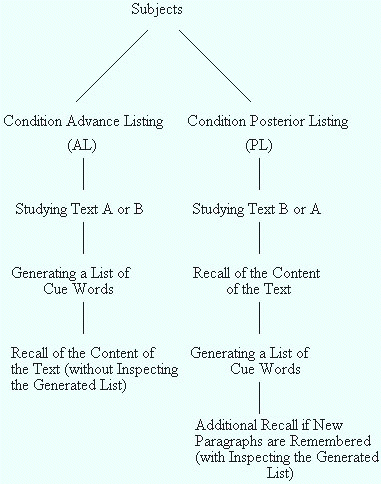
Next, participants were given 15 minutes to perform an interpolated task, during which they answered questions regarding their field of study. Such a retention interval was included to prevent recall from short-term memory. Then participants received a form with one column of 14 numbered lines. To carry out the task of self-generation of cues, they were asked to generate from memory a list of short indications (one or a few words) of the 14 paragraphs they had studied at the study phase. Participants were informed that the serial order of the generation of short indications did not have to coincide with the original serial order of the paragraphs in each text. After this listing, the papers were collected and participants were given enough time to recall and write down the contents of the texts they had studied at the study phase. During written recall, participants did not have access to their generated lists or the notes they had made while reading the texts. Figure 1. shows the procedures followed in each condition.
|
Figure 1: The procedures followed in conditions AL and PL
Under condition PL, participants who had studied text A in condition AL received text B and those who had studied text B in AL received text A. The study procedure was the same for both conditions except that there was no self-generation task after reading under PL condition. Upon reading the texts, participants performed a 15-minute interpolated task followed by a recall task during which participants wrote down the contents of the texts they had studied. Again participants were not allowed to use notes of any kind during recall. As soon as the written recall task was completed, participants' recall protocols were collected and participants were provided with a form including a column of 14 numbered lines to generate short indications for the paragraphs of the text according to the same instructions provided in condition AL. As soon as participants completed the generation of cues, they were given a chance to recall and write down the contents of any additional paragraphs they could recall, to supplement their previous recalls.
Unlike in condition AL, participants were allowed at this stage of condition PL to inspect their self-generated cues. This was done to test the effect of access to self-generated cues at recall. The supplementary protocols and the sheets including participants' self-generated cues were then collected and made ready for analysis. Since there were two recall tasks involved in condition PL (ie., one before self-generation and one after that), the first one will be referred to as PL1 and the second PL2 in the analysis of the data.
| Source | DF | SS | MS | F | P |
| Factor | 2 | 20.27 | 10.13 | 5.19 | 0.007 |
| Error | 87 | 169.83 | 1.95 | ||
| Total | 89 | 190.10 |
Post hoc analyses of the mean pairs, using Bonferroni test, reveal that: a) AL mean score is significantly higher than PL1 mean score (p = 0.0081) (see Table 2), b) PL2 mean score is significantly higher than PL1 mean score (p = 0000.0) (see Table 3), c) there is no significant difference between PL2 and AL (p = 0.71) (see Table 4).
| N | Mean | SD | SE Mean | T | p value |
| 30 | 0.933 | 1.799 | 0.328 | 2.84 | 0.0081 |
Table 3: The results of computing t value between the mean scores in PL1 and PL2
| N | Mean | SD | SE Mean | T | p value |
| 30 | 1.067 | 1.081 | 0.197 | -5.41 | 0.0000 |
Table 4: The results of computing t-value between the mean scores AL and PL2
| N | Mean | SD | SE Mean | T | p value |
| 30 | -0.133 | 1.925 | 0.351 | -0.38 | 0.71 |
Therefore, it can be concluded that: a) self-generation of the retrieval cues prior to recall had a significantly facilitating effect on the recall of the paragraphs of the narrative texts, when inspection of the generated lists during written recall was not allowed, b) the self-generation of the retrieval cues subsequent to recall had a significantly facilitating effect on the recall of the paragraphs of the narrative texts, when the inspection of the generated list during written recall was allowed, c) there was no significant recall advantage for the inspection condition over the non-inspection condition. It should of course be borne in mind that these two conditions differed from each other in more respects than just the inspection.
| Condition | N | Mean | SD | t-value | p-value |
| AL | 30 | 0.5308 | 0.0739 | 0.79 | 0.43 |
| PL | 30 | 0.5153 | 0.0777 |
Since only a few participants recalled more than 10 paragraphs in each passage, only the first 10 paragraphs of each passage were taken into account and the calculations were based on those 10. This was done to prevent the effect of these few participants' recall on the overall results.
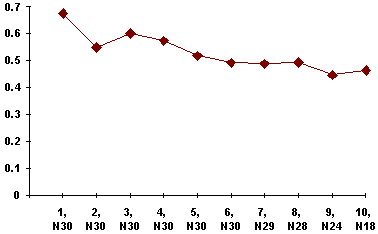
Figure 2: The serial position of output of the paragraphs 1 through 10 and the
completeness with which the paragraphs were recalled in AL
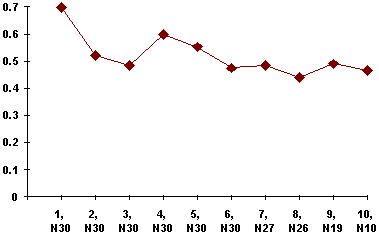
Figure 3: The serial position of output of the paragraphs 1 through 10 and the
completeness with which the paragraphs were recalled in PL (initial reproductions)
It was assumed, prior to this study, that the facilitating effect of a self-generated list might be increased if inspection of the list was allowed during recall. The results, however, did not support this hypothesis.
The results have also shown that self-generation of the retrieval cues does not affect the completeness with which the paragraphs are recalled. These results also support the findings of van Dam, Brinkerink-Carlier, and Kok, (1987) that during oral recall of the paragraphs of an expository text, inspection of self-generated cues has no effect on the completeness of recalled paragraphs (t(34) = 0.97).
In order to obtain an impression of the effect of serial position of the output on the completeness with which the paragraphs were recalled, Figures 2 and 3 were presented. These figures clearly indicate a decrease in the completeness values of the paragraphs recalled at later serial positions of output, suggesting that paragraphs recalled at earlier serial positions were recalled more completely, whether the lists of cue words were generated prior to recall or not. These findings are consistent with the findings of Smith, d'Agostino, & Starling-Reid (1970) and van Dam, Brinkerink-Carlier, and Kok, (1987). Smith, d'Agostino, & Starling-Reid found a strong negative correlation between output order and completeness of recalled categories from a categorised list of items. van Dam, Brinkerink-Carlier, and Kok, also reported a similar relationship between the serial position of output and recall of the paragraphs of an expository text in an oral recall test.
Overall, research has so far shown a facilitating effect on recall for the self-generation of retrieval cues, both in first language and second language. In the context of English language teaching (ELT), it is suggested then that curriculum developers allow for maximal self-generation on the part of learners in devising teaching methodologies and designing course syllabi for language learners.
Gorrell, J. Tricou, C. & Graham, A (1991). Children's short- and long-term retention of science concepts via self-generated examples. Journal of Research in Childhood Education, 5, 100-108.
Hill, R. D. Allen, C. & Gregory, K. (1990). Self-generated mnemonics for enhancing free recall performance in older learners. Experimental Aging Research, 16, 141-145.
Hill, R. D. Shwob, S. L. & Ottman, S. (1993). Self-generated mnemonics for number recall in young and old adults. Perceptual & Motor Skills, 76, 467-470.
Jafarpur, A., Sadighi, F., & Tahririan, M. H. (1983). A basic course in reading English for university students. Shiraz: Shiraz University Press.
Kim, S. & Van Dusen, L. M. (1998). The role of prior knowledge and elaboration in text comprehension and memory: A comparison of self-generated elaboration and text-provided elaboration. American Journal of Psychology, 111, 353-379.
Kinjo, H. & Snodgrass, J. G. (2000). Does the generation effect occur for pictures? American Journal of Psychology, 113, 95-117.
Moshfeghi, F. & Sharifian, F. (1998a). Generation effect and associative learning, Journal of Education and Psychology Research, 1, 1-20.
Moshfeghi, F. & Sharifian, F. (1998b). The effect of two different degrees of generation on memory. Proceedings of the Fourth Conference on Linguistics. Tehran: Allameh Tabatabaie University Press.
Smith, A. D., d'Agostino, P. R., & Starling Reid, L. (1970). Output interference in long-term memory. Canadian Journal of Psychology, 24: 85-89.
Van Dam , G. & Brinkerink-Carlier, M.(1988). The effects of self-generation of retrieval cues during learning or recall of a text. Journal of General Psychology, 115, 151-159.
Van Dam , G. & Brinkerink-Carlier, M. (1989). The influence of self-cueing on recall of a text containing both plot-relevant and plot-irrelevant materials. Journal of General Psychology, 116, 109-119.
Van Dam , G. & Brinkerink-Carlier, M. (1990). Free recall of a text containing isolated paragraphs only. Perceptual & Motor Skills, 70, 523-530.
Van Dam , G., Brinkerink-Carlier, M., & Kok, I. (1987). The effects of self-generated cues on recall of the paragraphs of a text. Journal of General Psychology, 114, 135-146.
| Author: Farzad Sharifian, PhD Center for Applied Language & Literacy Research Edith Cowan University 2 Bradford St, Mount Lawley, Western Australia, 6050 Email: f.sharifian@cowan.edu.au Tel: +61 8 9370 6732 Fax: +61 8 9370 6155 Please cite as: Sharifian, F. (2000). The effect of self generated cues on ESL learners' recall of narrative texts. Proceedings Western Australian Institute for Educational Research Forum 2000. http://www.waier.org.au/forums/2000/sharifian.html |