Associations between teacher-student interpersonal behaviour, gender, cultural background and achievement
Tony Rickards and Darrell FisherCurtin University of Technology

[ Proceedings Contents 1996 ] [ Abstracts 1996 ] [ WAIER Home ]
Associations between teacher-student interpersonal behaviour, gender, cultural background and achievementTony Rickards and Darrell FisherCurtin University of Technology |
|
In order to achieve the competitive edge needed for Australia's economic well-being, it is essential that more young people successfully complete a high quality education in science (see A National Statement on Science for Australian Schools, Australian Education Council, 1992). Unfortunately, at a time when so much depends on science education, it has been found wanting both in Australia and overseas in terms of low participation rates (Dekkers, de Laeter & Malone, 1991), inappropriate curricula (Prime Minister's Science Council, 1990) and failure to emphasise higher-level learning (Tobin, Kahle & Fraser, 1990). Moreover, international comparisons show that Australian students' achievement has dropped from a high relative position in 1970 to below the international average in 1983 (Postlethwaite & Wiley, 1992).
At no other time in history has there been such an awareness around the world of the importance of ensuring that girls receive an equitable education. In Australia, the National Action Plan for the Education of Girls 1993-97 (Australian Education Council and Curriculum Corporation, 1993) highlights this concern. Of all school subjects, probably the greatest inequity between the sexes in enrolments, achievement and attitudes occurs for science (Parker, Rennie & Fraser, 1996; Young & Fraser, in press). This study is likely to have implications for improving one important aspect of science teaching (namely, the quality of the interpersonal interactions between teachers and students) and to enhance our understanding of differences between boys and girls in their interactions with teachers.
Furthermore, there is an awareness that Australian classrooms are becoming increasingly multicultural and that the way in which people communicate and perceive communication is culturally influenced (Giles & Franklyn-Stokes, 1989; Segall et al., 1990). The study investigates differences in the way in which teachers interact with students from different cultures.
The instruments that have been used in studies of learning environments often are related to the theoretical framework for human environments proposed by Moos (1974). One of the three major types of dimensions delineated by Moos is a relationship dimension. The interpersonal and interactional behaviour between teachers and their students provides an example of an important relationship dimension; it is teacher-student interpersonal interaction which forms the focus of the proposed study.
With the systems perspective in mind, Wubbels, Creton
and Hooymayers (1985) developed a model to map interpersonal teacher
behaviour extrapolated from the work of Leary (1957). This model
has been used in The Netherlands in the development of an instrument,
the Questionnaire on Teacher Interacion (QTI), to gather
students' and teachers' perceptions of interpersonal teacher behaviour
(Wubbels, Brekelman & Hooymayers, 1991; Wubbels & Levy,
1993). This model maps interpersonal behaviour with the aid of
an influence dimension (Dominance, D - Submission, S) and
a proximity dimension (Cooperation, C - Opposition, O).
These dimensions are represented in a coordinate system divided
into eight equal sectors (see Figure 1). Every instance
of interactional teacher behaviour can be placed within this system
of axes. The closer the instances of behaviour are in the chart,
the more closely they resemble each other.
The sections are labelled DC, CD, CS, SC, SO, OS, OD and DO according to their position in the coordinate system. For example, the two sectors DC and CD are both characterised by Dominance and Cooperation. In the DC sector, however, the Dominance aspect prevails over the Cooperation aspect, whereas the adjacent sector CD includes behaviours of a more cooperative and less dominant character. Figure 1 shows typical behaviours in each sector, as well as the names of the behaviours (e.g., leadership behaviour, helping/friendly behaviour, understanding behaviour) given to each sector. The QTI contains eight scales based on the eight parts of the model. A typical item in the OD scale is "This teacher gets angry unexpectedly".
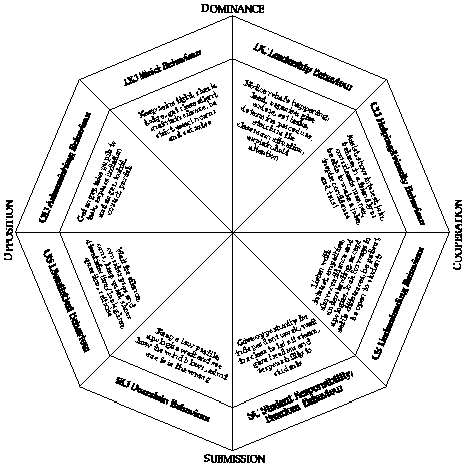
Figure 1: The model of interpersonal teacher behaviour
An Australian version of the QTI was used in a pilot study involving upper secondary science classes in Western Australia and Tasmania (Fisher, Fraser & Wubbels, 1993; Fisher, Fraser, Wubbels & Brekelmans, 1993). This pilot study strongly supported the validity and potential usefulness of the QTI within the Australian context, and suggested the desirability of conducting further and more comprehensive research involving the QTI.
Thus, the objectives of the proposed study were to provide further validation information for the QTI (in terms of reliability, scale independence, ability to differentiate between classrooms, etc.) when used with a large Australian sample; to investigate gender difference in students' perceptions of teacher interpersonal behaviour; to investigate cultural differences in students' perceptions of teacher interpersonal behaviour; and to investigate whether the nature of interpersonal teacher behaviour (as perceived by students or teachers) affects student achievement and attitudes.
As stated previously, cultural background was determined by asking students what language is normally spoken at home and their parents' birthplace. Attitude to class was assessed using a seven-item scale based on the Test Of Science Related Attitudes (TOSRA) (Fraser, 1981; Fisher, Henderson & Fraser, 1995) and teacher-student interpersonal behaviour was assessed using the QTI.
In addition, each student's performance on a school bench-mark test was provided by the classroom teacher and used as a measure of cognitive achievement. To enable meaningful comparisons, standardised scores (expressed in terms of the number of standard deviations above or below the group mean) were calculated.
Another desirable characteristic of any instrument like the QTI is that it is capable of differentiating between the perceptions of students in different classrooms. That is, students within the same class should perceive it relatively similarly, while mean within-class perceptions should vary from class to class. This characteristic was explored for each scale of the QTI using one-way ANOVA, with class membership as the main effect. It was found that each QTI scale differentiated significantly (p<.001) between classes and that the eta2 statistic, representing the proportion of variance explained by class membership, ranged from 0.22 to 0.35 for different classes.
| Table 1: Internal consistency (Cronbach Alpha Coefficient) and ability to differentiate between classrooms for the QTI | |||
| Scale | Unit of analysis | Alpha reliability | ANOVA results (eta2) |
| Leadership | Individual | 0.82 | 0.33* |
| Class mean | 0.93 | ||
| Helping/friendly | Individual | 0.88 | 0.35* |
| Class mean | 0.96 | ||
| Understanding | Individual | 0.85 | 0.32* |
| Class mean | 0.95 | ||
| Student resp/ freedom | Individual | 0.66 | 0.26* |
| Class mean | 0.82 | ||
| Uncertain | Individual | 0.72 | 0.22* |
| Class mean | 0.87 | ||
| Dissatisfied | Individual | 0.80 | 0.23* |
| Class mean | 0.93 | ||
| Admonishing | Individual | 0.76 | 0.31* |
| Class mean | 0.87 | ||
| Strict | Individual | 0.63 | 0.23* |
| Class mean | 0.78 | ||
| *p <.001 n = 3994 students in 185 classes. | |||
| Table 2: Scale means and standard deviations for male and female science and mathematics students' scores on the eight scales of the QTI | |||||
| Scale | Scale mean | Difference | Standard deviation | ||
| Male | Female | Male | Female | ||
| Leadership | 2.75 | 2.80 | 0.05* | 0.76 | 0.73 |
| Helping/friendly | 2.78 | 2.94 | 0.16** | 0.94 | 0.85 |
| Understanding | 2.79 | 2.92 | 0.13** | 0.85 | 0.81 |
| Student resp/ freedom | 1.69 | 1.67 | 0.02 | 0.65 | 0.65 |
| Uncertain | 1.01 | 0.83 | 0.18** | 0.75 | 0.67 |
| Dissatisfied | 1.20 | 0.95 | 0.25** | 0.84 | 0.79 |
| Admonishing | 1.47 | 1.27 | 0.20** | 0.86 | 0.81 |
| Strict | 1.85 | 1.78 | 0.07** | 0.67 | 0.64 |
| * p <.05 males n = 2026 ** p <.01 females n = 1926 | |||||
When primary language spoken at home was used as the cultural variable, it was found that children from homes where Asian-based languages were dominant had statistically significant higher mean scores on the scales of Leadership, Helping/Friendly, Understanding and Student Responsibility/Freedom. Again students from an Asian background perceived their teachers' interpersonal behaviourmore positively than students from other cultures.
| Table 3: Mean score and standard deviation for fathers' birthplace for each scale of the QTI | ||||||||
| Scale | Mean scores | F value | ||||||
| Europe | SE Asia | Asia | Oceania | Africa | North America |
South America | ||
| Leadership | 2.76 | 2.92 | 2.93 | 2.76 | 2.64 | 2.90 | 2.67 | 1.68 |
| Helping/friendly | 2.82 | 3.02 | 3.08 | 2.86 | 2.50 | 2.73 | 2.81 | 2.83** |
| Understanding | 2.85 | 2.95 | 2.97 | 2.85 | 2.72 | 2.76 | 2.83 | 0.69 |
| Student resp/freedom | 1.70 | 1.72 | 1.91 | 1.67 | 1.56 | 1.60 | 1.49 | 2.13* |
| Uncertain | 0.90 | 0.87 | 0.86 | 0.94 | 0.94 | 1.11 | 0.80 | 0.72 |
| Dissatisfied | 1.10 | 1.07 | 1.01 | 1.07 | 1.33 | 0.97 | 1.17 | 1.00 |
| Admonishing | 1.37 | 1.29 | 1.35 | 1.37 | 1.45 | 1.35 | 1.58 | 0.45 |
| Strict | 1.80 | 1.86 | 1.74 | 1.82 | 1.94 | 1.69 | 1.83 | 0.69 |
| *p < .05 **p < .01 ***p < .001 n = 3994 | ||||||||
| Table 4: Mean scores for primary language spoken at home for each scale of the QTI | ||||
| Scale | Mean scores | F value | ||
| English | Other European | Asian | ||
| Leadership | 2.77 | 2.59 | 2.92 | 4.38* |
| Helping/friendly | 2.86 | 2.64 | 2.99 | 3.66* |
| Understanding | 2.85 | 2.70 | 2.98 | 2.49 |
| Student resp/freedom | 1.68 | 1.75 | 1.89 | 4.08 |
| Uncertain | 0.92 | 1.04 | 0.99 | 1.62 |
| Dissatisfied | 1.07 | 1.22 | 1.18 | 2.02 |
| Admonishing | 1.37 | 1.48 | 1.34 | 0.86 |
| Strict | 1.81 | 1.85 | 1.82 | 0.13 |
| *p < .05 n = 3959 | ||||
| Table 5: Associations between QTI scales and students attitudinal outcomes in terms of Simple Correlations (r) and Standardised Regression Coefficients (beta) | ||||
| Scale | Attitude to class | Achievement score | ||
| r | beta | r | beta | |
| Leadership | 0.54** | 0.20** | 0.14** | 0.04 |
| Helping/friendly | 0.62** | 0.28 | 0.14** | 0.02 |
| Understanding | 0.57** | 0.05* | 0.14** | 0.00 |
| Stud resp/freedom | 0.16** | 0.01 | -0.01 | -0.03 |
| Uncertain | -0.34** | -0.01 | -0.11** | 0.01 |
| Dissatisfied | -0.51** | -0.07** | -0.19** | -0.15** |
| Admonishing | -0.48** | -0.05* | -0.13** | 0.00 |
| Strict | -0.41** | -0.20** | -0.10** | -0.02 |
| Multiple correlation, R | 0.67** | 0.20** | ||
| *p < .05 **p < .01 n = 2960 | ||||
Table 5 reports the results for associations between students' perceptions of teacher-student interpersonal behaviour and students' attitudinal and cognitive outcomes when the data were analysed using both simple and multiple correlations. Whereas the simple correlation (r) describes the bivariate association between an outcome and a QTI scale, the standardized regression weight (beta) characterises the association between an outcome and a particular QTI scale when all other QTI dimensions are controlled.
An examination of the simple correlation (r) figures in Table 5 indicates that there were 14 significant relationships (p<.05), out of 16 possible, between student-teacher interactions and student outcome variables; this is 15 times that expected by chance alone. An examination of the beta weights reveals 6 out of 16 significant relationships (p<.05), which is 6 times that expected by chance.
The multiple correlation (R) data reported in Table 5 indicate that associations were strongest between students' perceptions of teacher interpersonal behaviour and attitudinal outcomes. Simple correlation (r) figures indicate statistically significant associations between students' attitudinal and all QTI scales. These associations were positive for the scales on the right side of the model of interpersonal behaviour and negative for the scales on the left side of the model. An examination of the beta weights reveals that the greatest contribution to attitude occurred when teachers exhibited more leadership, helpful/friendly and understanding behaviours in their classrooms and were less strict, dissatisfied and admonishing. Cognitive achievement was higher where the teachers demonstrated more leadership, helpful/friendly and understanding behaviours and less strict, dissatisfied and admonishing behaviours. The more conservative multiple regression indicated that it was the Dissatisfied scale that was negatively associated with cognitive achievement.
It was found that student perceptions of teacher-student interpersonal behaviour were related to their achievement and their attitude to class. It was found that the greatest contribution to attitude occurred when teachers exhibited more leadership, helpful/friendly and understanding behaviours in their classrooms and were less strict, dissatisfied and admonishing.
An analysis of gender differences revealed that there were statistically significant differences in the way that males and females perceived their teachers interpersonal behaviour. Females perceived their teachers' interpersonal behaviour in a more positive way than did males. There were differences in the perceptions of students from different cultural backgrounds when primary language spoken at home was the cultural variable. Students for whom Asian-based languages were dominant had statistically different mean scores on some scales of the model for interpersonal behaviour and tended to perceive their teachers more positively than students from other cultures.
This research has contributed to educational theory by elaborating the relationship dimension of the Moos conceptualisation of learning environments through the application of the Leary model of interpersonal behaviour. The study also has practical significance in that it has developed a procedure that can be used by teachers to monitor what is occuring in their own classrooms and to guide improvements in their own teaching, thus leading to improved learning among students.
Australian Education Council and Curriculum Corporation. (1993). National action plan for the education of girls 1993-97. Melbourne: Curriculum Corporation.
Dekkers, J., de Laeter, J. & Malone, J. (1991). Upper secondary school science and mathematics enrolment patterns in Australia, 1970-1989. Perth: Curtin University of Technology.
Efron, B. (1981). Nonparametric estimates of standard error: The jackknife, the bootstrap and other methods. Biometrica, 68(3), 589-599.
Erickson, F. (1986). Qualitative methods in research on teaching. In M.C. Wittrock (Ed.), Handbook of research on teaching (3rd ed). New York: Macmillan.
Finifter, B. (1972). The generation of confidence: Evaluating research findings by random sub-sample replication. In M. Costner (Ed.), Sociological Methodology, 1972. San Francisco: Jossey-Bass.
Fisher, D., Fraser, B. & Wubbels, Th. (1993). Interpersonal teacher behavior and school environment. In Th. Wubbels and J. Levy (Eds.), Do you know what you look like: Interpersonal relationships in education. London: Falmer Press.
Fisher, D., Fraser, B., Wubbels, Th. & Brekelmans, M. (1993, April). Associations between school environment and teacher interpersonal behavior in the classroom. Paper presented at the annual meeting of the American Educational Research Association, Atlanta, GA.
Fisher, D., Henderson, D. & Fraser, B. (1995). Interpersonal behaviour in senior high school biology classes. Research in Science Education, 25(2), 125-133.
Fraser, B.J. (1981). Test of Science-Related Attitudes. Melbourne: Australian Council for Educational Research.
Fraser, B. (1986). Classroom environment. London: Croom Helm.
Fraser, B. (1994). Research on classroom and school climate. In D. Gabel (Ed.), Handbook of Research on Science Teaching and Learning. New York: Macmillan.
Fraser, B. & Fisher, D. (1982). Predicting students' outcomes from their perceptions of classroom psychosocial environment. American Educational Research Journal, 19, 498-518.
Fraser, B., McRobbie, C. & Giddings, G. (in press). Evolution and validation of a personal form of an instrument for assessing science laboratory classroom environment. Journal of Research in Science Teaching.
Fraser, B. & Walberg, H. (Eds.). (1991). Educational environments: Evaluation, antecedents and consequences. Oxford: Pergamon Press.
Giles, H. & Franklyn-Stokes, A. (1989). Communicator characteristics. In M. Asante and W. Gudykunst (Eds.), Handbook of international and intercultural communication. Newbury Park, CA: Sage.
Goldstein, H. (1987). Multi-level models in educational and social research. London: Charles Griffin.
Leary, T. (1957). An interpersonal diagnosis of personality. New York: Ronald Press Company.
Levy, J., Wubbels, Th. & Morganfield, B. (1994, April). Language and cultural factors in students' perceptions of teacher communication style. Paper presented at annual meeting of American Educational Research Association, New Orleans, LA.
Moos, R.H. (1974). The social climate scales: An overview. Palo Alto, CA: Consulting Psychologists Press.
Parker, L., Rennie, L. & Fraser, B. (Eds.). (1996). Gender, science and mathematics: Shortening the shadow. Dordrecht, The Netherlands: Kluwer.
Postlethwaite, T. & Wiley, D. (1992). The IEA study of science II: Science achievement in twenty-three countries. Oxford: Pergamon Press.
Prime Minister's Science Council. (1990). Science and mathematics in the formative years. Canberra: Australian Government Publishing Service.
R audenbush, S. & Bryk, A. (1986). Quantitative models for estimating teacher and school effectiveness. In R. Bock (Ed.), Multilevel analysis of educational data. San Diego: Academic Press.
Segall, M.H., Dasen, P.R., Berry, J.W. & Poortinga, Y.H. (Eds.). (1990). Human behavior in global perspective: An introduction to cross-cultural psychology. New York: Pergamon.
Tobin, K., Kahle, J. & Fraser, B. (Eds.). (1990). Windows into science classrooms: Problems associated with higher-level cognitive learning. London: Falmer Press.
Watzlawick, P., Beavin, J. & Jackson, D. (1967). The pragmatics of human communication. New York: Norton.
Wubbels, Th., Brekelmans, M. & Hooymayers, H.P. (1991). Interpersonal teacher behavior in the classroom. In B. Fraser and H. Walberg (Eds.), Educational environments: Evaluation, antecedents and consequences. Oxford: Pergamon Press.
Wubbels, Th., Creton, H.A. & Holvast, A. (1988). Undesirable classroom situations. Interchange, 19(2), 25-40.
Wubbels, Th., Creton, H. & Hooymayers, H. (1985). Discipline problems of beginning teachers. Paper presented at annual meeting of American Educational Research Association, Chicago, IL. (ERIC Document 260040)
Wubbels, Th. & Levy, J. (Eds.). (1993). Do you know what you look like: Interpersonal relationships in education. London: Falmer Press.
Young, D. & Fraser, B. (in press). A multilevel model of sex differences in science achievement: The Australian Second International Science Study. Journal of Research in Science Teaching.
| Authors: Tony Rickards and Darrell Fisher, Curtin University of Technology, erickards@cc.curtin.edu.au
Please cite as: (1996). Associations between teacher-student interpersonal behaviour, gender, cultural background and achievement. Proceedings Western Australian Institute for Educational Research Forum 1996. http://www.waier.org.au/forums/1996/rickards.html |